Skip to content
IAS TL-732LADBS TA24846
SMHE Lab

Certification · SMHE Certified

SMHE Certified: certification backed by evidence, not assertion

The SMHE Certified seal is not a logo a manufacturer buys. It is a statement that a product’s engineering assumptions were examined against physical evidence and found defensible — backed by evidence held in controlled records. Certificate numbers can be checked through the SMHE public registry.

About this programSMHE Certified is SMHE’s product certification program. Certificates issued under the earlier S-Mark name retain their original certificate numbers and records.

What the mark means

What does SMHE Certified status mean?

Answer

SMHE Certified status means that a product was evaluated against the stated standard or technical basis, and that the finished-product behavior, not just the material certificate, supports the engineering. The certification is renewable, because assumptions age as standards, materials, and processes change. The evidence behind the seal lives in controlled records, and certificate numbers can be checked through the SMHE public registry.

Three commitments define the SMHE Certified program:

  • A stated basis. The product was evaluated against the stated standard or technical basis.
  • Finished-product behavior. The finished-product behavior supports the engineering, not just the material certificate.
  • Renewable by design. The certification is renewable, because assumptions age as standards, materials, and processes change.
SMHE Certified seal carrying certificate number IPC 021226001

The principle behind it

How can a certification mark be checked without disclosing design data?

Answer

The full truth lives in the controlled record; the public certification mark is a verifiable fingerprint of that truth. The program is designed so that a manufacturer can stand behind a certified claim without exposing proprietary design detail, and a specifier can verify the mark without needing the underlying data. That is trust without disclosure.

Each SMHE Certified certification rests on a controlled record: the specimens, the reference setup, the measured behavior, the certification scope, the dates. The mark on a product carries none of that detail — only a certificate number that points back to the record. Verification confirms the registry entry associated with the certificate number; the record itself never has to leave the lab.

That architecture is designed to serve both sides of the transaction. The manufacturer’s geometry, tooling, and process data stay proprietary. The specifier, the buyer, or the approval agency can check a confirmation in seconds, against a public record — without taking anyone’s word for anything.

Trust without disclosure.

Why third-party testing matters

Verify a certificate

A mark that cannot be verified is not a certification.

Verification checks a certificate number against the public registry, the index of the controlled records, and returns the status SMHE has recorded, along with the certificate title, the certificate holder, the product, the standards, the issue date, and the renewal review date where one is recorded.

The mark never travels alone: every SMHE Certified seal carries its assigned certificate number, and that number is what you verify. A mark separated from a verifiable number is not a certification.

Verify a certificate

The SMHE Certified seal carrying certificate number IPC 021226001, an issued certificate
Certification mark and certificate number
The mark plus its certificate number — the pair the verification portal checks.

The certification lifecycle

A loop, not a one-time event.

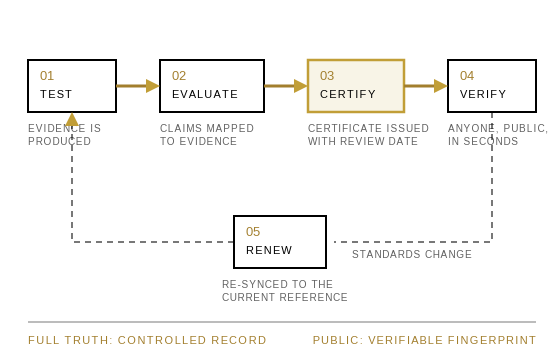
Testing produces the evidence. Evaluation connects that evidence to specific claims within a defined scope. Certification issues a mark with a scheduled renewal review. Verification lets anyone check it in seconds. And renewal closes the loop — because standards, materials, and processes keep moving after the certificate is printed.

These are three distinct functions, and all three are SMHE functions. Testing generates and reports evidence. Engineering evaluation applies that evidence to a design, product, or conformity question that requires engineering judgment. SMHE Certified makes and maintains the certification decision. They are distinguished by the function performed and the decision each one makes; they are not separate organizations.

The certification lifecycle: test, evaluate, certify, verify, renew — a loop in which the controlled record stays private and the public verifies its fingerprint
The lifecycle: evidence in, verifiable mark out, renewal on a defined cycle.

The evidence packet

What stands behind a certified claim?

Each SMHE Certified certification sits on an organized evidence packet. Part of it is public by design; part of it stays controlled by design. Both parts are the point.

Public — what anyone can see

  • Product identity and family
  • Evaluation standard or technical basis, edition identified
  • Certification scope — honestly bounded
  • Issue date and renewal review date
  • Current status, checkable at /verify
  • The certificate number — ties the public entry to its controlled record

Controlled — what stays in the record

  • Complete test reports with specimen provenance
  • Quantitative results and derivations
  • Drawings and proprietary design detail
  • The evaluation logic connecting results to claims

The program is designed so that a manufacturer can stand behind a certified claim without exposing design detail, and a specifier can verify the mark without needing the underlying data. Trust without disclosure.

The packet’s structure — claims register, standards, reports, evaluation logic — is described on the Test reports page under Certification Packages.

Governance

Who stands behind SMHE Certified?

Answer

SMHE Certified is a product certification program operated by SMHE. It is designed around defined product scope, tested evidence, engineering evaluation, controlled certification records, and public registry verification — so that mark use is controlled, renewal runs on a defined cycle, and certification can be suspended, revoked, or made subject to corrective action when certification conditions are not maintained.

  • Testing and certification are separate activities. The evidence comes from SMHE’s ISO/IEC 17025-accredited laboratory system, where the work is within the published scope; certification is a separate, SMHE-operated evaluation of that evidence against the program’s defined criteria. SMHE does not represent SMHE Certified as accredited under ISO/IEC 17065.
  • Certification is scoped, not transferable. An SMHE certification is issued for defined products and configurations. It does not extend to variations the program has not reviewed.
  • The mark stays attached to its number. Use of the SMHE Certified seal must remain associated with its assigned certificate number — a mark separated from a verifiable number is not a certification.
  • Status is designed to be public, including the bad news. Suspension and revocation are designed to be visible in the public registry, which indexes SMHE’s controlled certification records.

That separation is drawn in the sealwork itself. Two seals share one geometry — three principles hold a triangle each — but they mark different things and never trade places:

SMHE Certified · public certification mark

SMHE Certified seal carrying certificate number IPC 021226001
  • Evidence — objective, measured test data
  • Certification — evaluation against defined criteria
  • Verification — public registry confirmation
  • Trust — held in the negative space where the three meet
The SMHE Certified seal, in motion · 21 s

Product labels · certificates · registry pages · public communications

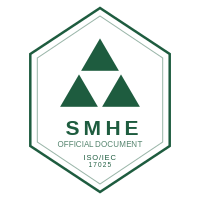
SMHE Official Document · internal / operational

SMHE Official Document seal — internal and operational documents, ISO/IEC 17025 laboratory system
  • Competence — qualified people, validated methods
  • Impartiality — conclusions governed by test evidence and method
  • Traceability — every number back to NIST
  • Integrity — the balance of the three
The SMHE Official Document seal, in motion · 20 s

Test reports · calculations · procedures · drawings

The SMHE Certified seal appears only where a certificate number can be verified; the SMHE Official Document seal marks documents issued under SMHE’s laboratory quality system and never appears on a product. Keeping the two apart is part of how the boundary between testing and certification stays visible.

SMHE Certified is evidence-backed certification, not a marketing logo.

The renewal model

Why is an SMHE certification reviewed for renewal?

Answer

A certification that is never re-examined is a screenshot of trust. Standards evolve — a revised connection provision between editions can change results with no fanfare — so each certification carries a scheduled renewal review, designed to re-synchronize it with the current reference. A reviewed certification means currently defensible, not once defensible.

Standards evolve quietly. A provision revised between editions can move results with no announcement — the same product, tested to the new reference, can carry a different margin to failure. Materials and processes drift the same way: a new coil supplier, a retooled press, a changed weld sequence, none of which appear on a drawing.

Renewal is designed to bring product, standard, and evidence back into agreement on a defined cycle, marked by a renewal review date. The review date is not an expiration date: verification shows the status SMHE has recorded, so a reader sees whether a mark is current — not merely whether it was ever issued.

Scope honesty

What SMHE Certified does not do.

A mark you can trust is one that states its limits. Three things SMHE Certified deliberately does not claim:

Evidence, not authority

It does not replace an approval agency.

SMHE certification is engineering evidence, not jurisdictional authority. Where an approval agency or authority having jurisdiction must accept a product, SMHE certification is designed to supply defensible evidence from outside the manufacturer that acceptance relies on — it does not grant the acceptance itself.

Tested scope only

It certifies the tested scope, not every configuration.

The certificate states exactly which product, configuration, and standard were examined. A change in geometry, material, or process outside that scope is a new assumption — and a new question the existing evidence does not answer.

A complement, not a substitute

It complements broad recognition marks.

Where a general recognition mark is also required, SMHE Certified is designed to be the engineering-depth layer alongside it: finished-product behavior, validated to the reference, publicly verifiable.

For manufacturers

A validated assumption becomes a market-facing asset.

SMHE Certified is designed to convert the evidence a test produced into something the market can act on: verifiable, renewable evidence that your product’s engineering holds — without handing your design data to anyone.

  1. Test

    The product is tested, and evaluated against the stated standard or technical basis.
  2. Validate

    Measured behavior is compared against the engineering assumptions: load path, failure mode, margin to failure.
  3. Certify

    The evidence enters the controlled record, and the product carries a publicly verifiable SMHE Certified seal.
  4. Renew

    The certification is re-synchronized with the current reference as standards, materials, and processes change.

Request certification testing

Go deeper

The thinking behind the mark

Related reading

The testing behind it

Common questions

Who can verify a certificate?

Answer

Anyone, without an account: a specifier at a desk, an inspector on a warehouse floor, a buyer comparing products. Certificate numbers can be checked through the SMHE public registry: enter the number, and the portal returns the status, the certificate holder, the product, the standards, and the dates on record in seconds.

What happens if a certification is suspended, withdrawn, or revoked?

Answer

Its public status changes to the determination SMHE records. Suspended means the certification is temporarily suspended; Withdrawn means it has been withdrawn and is no longer current, without implying cause; Revoked means SMHE has ended it for cause and it is no longer valid. The full status vocabulary is Current, Pending, Review Due, Expired, Suspended, Withdrawn, Revoked, and Unconfirmed, and it is public because trust requires the bad news too.

See how verification works.

The portal returns a certificate's status, holder, product, standards and dates on record from the public registry.

Request testing