On site
Field testing
Anchor proof-load and shear, slab uplift and downforce, concrete cores, torque verification, installed-condition testing.
Testing · Structural
SMHE Lab provides structural testing services for material handling equipment, warehouse storage systems, and related industrial products — in the laboratory and in the field. The question is not simply whether something held load. The question is whether the assumptions behind the design remain valid.
Design-assumption categories
One connection response measured. Applied to matching design joints.
Choose your path
On site
Anchor proof-load and shear, slab uplift and downforce, concrete cores, torque verification, installed-condition testing.
In the lab
Connection stiffness and cyclic behavior, member and assembly capacity, stability, materials, and impact — to the reference the standard defines.
For a claim
The evidence path from controlled testing to product certification.
The library
Every test framed by the question it answers, the assumption it checks, and what it does not prove.
What we do
SMHE Lab provides structural testing services for material handling equipment, warehouse storage systems, and related industrial products. Our testing helps manufacturers, engineers, inspectors, and product-development teams evaluate how products perform under controlled loading — including intended use, overload behavior, manufacturing variation, and other design-critical variables.
Structural testing is not only about recreating real-world use. More importantly, it validates the engineering assumptions behind the calculations. A product may look familiar, but small changes in material, geometry, fabrication, connection details, restraint conditions, or load path can affect how it actually behaves. Testing provides documented evidence that confirms whether the assumptions used in engineering analysis remain valid.
Five services
Every service exists to answer a specific engineering question. Scope the test by the question you need answered.
Service 01 · Performance validation
Controlled loading to the applicable standard confirms whether finished-product behavior — stiffness, capacity, deformation — still matches what the analysis assumed.
Service 02 · Destructive testing
Load increases until yielding, excessive deformation, instability, or fracture — identifying performance limits, the actual failure sequence, and the measured margin to failure.
Service 03 · Quality-control testing
Periodic testing catches what supplier, tooling, and process changes do to finished-product behavior — before quality inconsistencies become harder to identify.
Service 04 · Failure & field-concern investigation
After a field concern or failure, controlled testing reconstructs the actual load path and failure sequence to isolate the assumption that no longer held.
Service 05 · Certification-support testing
Documentation for engineering review, product evaluation, and certification submittals — including turnkey R-Mark packages: we test the components, and load tables are then developed from the measured behavior, as engineering evaluation, per RMI requirements.
Why it matters
Engineering calculations are built on assumptions — material properties, stiffness, ductility, boundary conditions, connection behavior, fabrication quality, load path, restraint, and expected use. Structural testing grounds those assumptions in observable behavior and documents whether they remain valid in the finished product.
Long service history can provide confidence that a product has performed over time. But service history alone does not replace testing when new variables are introduced. Changes in suppliers, materials, tooling, manufacturing processes, fabrication details, geometry, connections, or intended use can shift product behavior. Testing renews and verifies the assumptions behind the design.
Testing can also reveal behavior that is not obvious from drawings or calculations — an unexpected load path, connection response, restraint effect, deformation pattern, or failure sequence that only becomes clear under a controlled test.
The steel problem
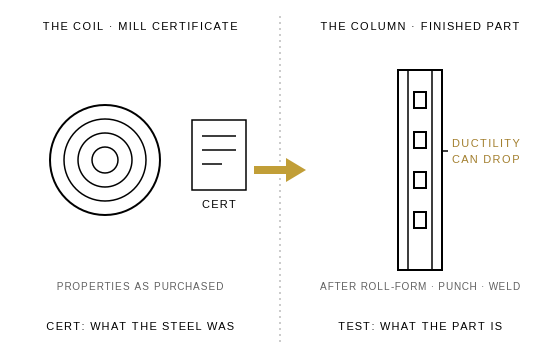
Because production changes the material. Roll forming, punching, welding, coating, and cold work can leave strength high while ductility drops, or narrow the yield-to-ultimate margin below what the structural use needs. The material certificate describes the steel as purchased — testing confirms the finished product.
Steel from a producer may meet its specification, but after roll forming, punching, welding, coating, cold work, or other production effects, the finished component may not behave exactly as the material certificate suggests. Strength may remain high while ductility is reduced, or the margin between yield and ultimate strength may become too narrow for the intended structural use. Testing confirms the behavior of the finished product — not only the material as purchased.
The material certificate describes the coil, not the column
Material documentation
Mill certificates missing, incomplete, or not accepted for a project? Material acceptance is an evidence question, not a country-of-origin question — sometimes the documentation can carry it, and sometimes measured properties from the actual component are the evidence a reviewer needs.
The cost of not knowing
Without testing, performance assumptions remain unverified until field conditions test them for you. Product weaknesses, unexpected load paths, and production-induced losses of ductility can go undetected — and manufacturers lack the documentation that compliance and approval reviews rely on.
Who & when
Anyone whose product, process, or supplier has changed — and anyone who must show defensible evidence that assumptions still hold. Test during development, before launch, after modifications or field concerns, and whenever materials, tooling, fabrication, connections, or intended use change.
The process
Testing at SMHE Lab follows six steps: a scoping conversation, method and reference identification, specimen instrumentation, controlled loading, an engineering report, and optional SMHE certification. Each step exists to answer one question — whether the assumptions behind your engineering remain valid in the finished product.
Standards
We test to the reference the standard defines — not to convenience. Every result reports against the applicable standard, with NIST-traceable calibration behind the measurement.
| Standard | Scope |
|---|---|
| ANSI MH16.1 | Industrial Steel Storage Racks |
| ANSI MH16.3 | Cantilever Storage Racks |
| ANSI MH26.2 | Rack Decking |
| ANSI MH28.1 | Multi-Level Shelving Systems |
| ANSI MH28.2 | Boltless Metal-Wood Shelving |
| ANSI MH28.3 | Industrial Steel Work Platforms |
| ANSI MH29.1 | Industrial Scissors Lift Tables |
| ASTM A370 | Mechanical Testing of Steel Products |
| ASTM E8/E8M | Tension Testing of Steel |
| ASTM E3121 / ASTM E488 | Anchor — Slab Testing |
| AISI S907 | Diaphragm / Shear Panel — Cantilever Test Method |
Representative capabilities: beam-to-column cyclic testing, stub column, cantilever arm, shear panel, wire deck, anchor pulls, and compressive slab adjacent to control joint.
These standards illustrate areas of regular practice — they are not the boundary of what the laboratory can test. Testing is also performed to customer-defined procedures, engineering-specific requirements, and project-specific protocols, under the laboratory’s written quality system. Formal accreditation applies only to the published Scope of Accreditation (IAS TL-732).
SMHE Lab is an IAS ISO/IEC 17025 Accredited Testing Laboratory — Certificate TL-732 — and an LADBS Testing Agency, TA24846. See the credentials
FAQ
SMHE Lab tests material handling and warehouse-related products, including storage systems, rack components, structural components, guard products, wire partitions, safety equipment, and other engineered products used in industrial environments.
Structural testing is commonly used in warehousing, distribution, manufacturing, logistics, industrial storage, material handling, cold storage, retail distribution, and other industrial environments where engineered equipment must safely support or resist applied loads.
Destructive testing evaluates how a product performs under increasing load until yielding, excessive deformation, instability, fracture, or failure occurs — identifying performance limits, failure points, deformation behavior, and structural response.
Third-party testing gives you documentation from outside your own organization, produced to a written method, beyond internal claims, and reduces experience bias. A product may appear similar to a previous design, but changed materials, geometry, connections, fabrication, or restraint can alter stiffness, ductility, load path, and failure behavior.
Yes. SMHE Lab performs testing that may support engineering review, product evaluation, certification submittals, and approval-agency documentation. We do not replace the authority of the approving agency, but testing provides evidence used in that review.
Yes. Testing identifies inconsistencies, validates manufacturing processes, supports design improvement, and confirms whether production changes have affected ductility, connection behavior, load path, or performance in ways calculations alone may not capture.
Yes. Retesting evaluates how redesigns, modifications, repairs, or updates affect performance — and renews assumptions when suppliers, materials, tooling, fabrication, or intended use have changed.
Testing provides load data, deformation measurements, performance observations, failure analysis, engineering-validation support, and documented results — including actual load paths, deformation landmarks, ductility behavior, connection response, failure sequence, and whether the tested product supports the assumptions used in the engineering analysis.
We’ll help you find out whether your engineering still holds.