

Lab testing · Test type
Material Tensile Testing
Customer questionDoes the steel in our finished parts actually have the properties we designed around?
The short answer
What this test tells you
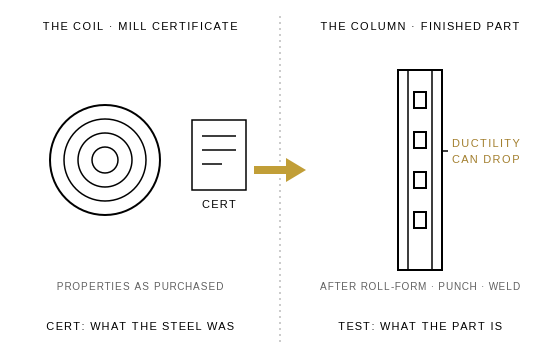
The paperwork that comes with steel describes the coil as it left the mill — not the finished part after it has been formed, punched, and welded. In this test, we cut small samples from your actual product and pull them in a calibrated machine until they break. The result tells you the real strength and ductility of the steel in the parts you sell or rely on. That measured data supports supplier decisions, engineering reviews, and certification submittals, and it catches quiet changes in material before they become a problem. Testing turns an assumption about your steel into evidence.
Material acceptance
Is the paperwork enough, or does the steel need to be tested?
The question we hearOur material is imported, or the records are incomplete — does it have to be retested?
Material acceptance is an evidence question, not a country-of-origin question. When acceptable documentation establishes the material properties used for design and maintains the required traceability to the material, additional physical testing may not be necessary. When that basis cannot be established, independent testing provides measured properties from the material actually submitted for evaluation.
When documentation is enough
Every structural design rests on a material basis: the yield strength, tensile strength, and ductility the engineer used as design inputs. A reviewer accepts material when evidence connects those properties to the material actually in the work. Usually that evidence is documentation — material identified by its markings and test records, tied to a recognized material specification.
Building codes in the United States carry that evidence principle in their identification provisions: steel is identified by its markings and test records to its specification, and steel that cannot be identified that way is tested to determine what it is. When the identification and the records hold, additional testing may not be necessary. The question the code asks is not where the material came from — it is whether the evidence establishes what the material is.
When independent testing earns its place
Independent testing becomes useful — or required — when the documentation can no longer carry the material basis on its own:
- Mill certificates are unavailable, incomplete, or not accepted by the reviewing authority
- Traceability from the documents to the actual component is uncertain
- The design needs finished-product properties, and forming, punching, or welding have changed the material since the certificate was issued
- Legacy material must be characterized and no records survive
- Incoming material is verified independently as a quality-assurance layer
- An engineer, building official, or project specification requires independently measured properties
- Reported material properties are disputed or uncertain
In each of these situations, the test does the same job: it establishes or supplements the material evidence with measured properties, traceable to identified specimens.
What this testing establishes
Tensile testing under ASTM A370 or ASTM E8/E8M measures yield strength, tensile strength, elongation, and the stress–strain behavior behind them — on coupons traceable to the specific material sampled. Where coupons are taken from a finished component, the results describe the material present in that component, after the manufacturing processes it has been through. That is measured evidence an engineer or reviewer can put under a design value.
What it does not establish
ASTM A370 establishes methods for the mechanical testing of steel products. It does not set how many samples a program needs, where coupons are taken, or what values are acceptable — sampling frequency, specimen location and orientation, and acceptance criteria come from the governing material specification, product specification, or project requirement. A370 does not by itself create a requirement to retest imported steel; whether testing is required at all is set by those governing requirements and the authority reviewing the project, not by the test method.
A tension test also establishes the mechanical properties of the sampled material only. It does not establish chemistry, weldability, or grade identity, and it does not speak for material that was not sampled — how far the results extend is a sampling question, answered by the governing specification or project requirement.
A mill test report and a test of the finished component are also not interchangeable evidence. The mill test report documents the material at a defined production condition — the coil or plate as it left the producer. Coupons removed from an actual finished component establish the measured properties of the material in that component after forming, punching, or welding. Each answers its own question; which one a project needs depends on what the evidence must establish.
Why it matters
What decision does the result support?
Rack design capacities depend on assumed material properties, including ductility and the relationship between yield and ultimate strength. If the finished part no longer matches those assumptions, calculated capacities rest on unverified inputs, and a supplier or tooling change can shift behavior without anyone noticing. Measured tensile data turns that assumption into evidence.
What the evidence supports
- engineering review
- product development
- product certification
- code/standard compliance support
- manufacturer claims
Typical project situations
- Qualifying a new steel supplier or coil source
- Verifying finished-part properties after roll forming or fabrication changes
- Providing measured material data alongside MH16.3 component test programs
- Investigating unexpected results from a component or assembly test
- Periodic quality checks on production steel
- Documenting material properties for engineering review or certification submittals
What you receive
Test reports
The primary deliverable is the test report: what was tested, to which reference, with what instrumentation, what was measured, and what the result means for the assumption in question. What a test report contains is described on the Test reports page.
Important distinctions
What does this test not prove?
A tensile test characterizes the material, not the member. It does not tell you what a column, beam, or connection can carry — that is the role of stub column, connection, and assembly testing. It also differs from the mill certificate: the certificate describes the steel as produced, while a tensile test on a finished part describes the steel after forming and fabrication. Impact toughness is a separate question answered by impact testing, not by a tensile test.
The question is not simply whether something held load. The question is whether the assumptions behind the design remain valid — and every test answers only the question it was designed to ask.
Whether this method is inside SMHE Lab’s accredited scope is stated in the Scope of Accreditation. Ask us to confirm before relying on an accredited result.
The assumption
What assumption does this test check?
The finished component retains the tensile strength, yield behavior, and ductility assumed in the design, not just the properties listed on the mill certificate.
What it evaluates
What does this test evaluate?
Material tensile testing measures the yield strength, tensile strength, elongation, and stress–strain behavior of steel, typically following ASTM A370 or ASTM E8/E8M. Coupons can be taken from finished components rather than raw coil, which matters because roll forming, punching, welding, and other cold work change material behavior. Strength may remain high while ductility drops, or the margin between yield and ultimate strength may narrow beyond what the design assumed. The test establishes what the material in the finished part actually does, not what the mill certificate says the coil did.
Technical detail
How does the test work?
A tensile test characterizes the steel itself. Coupons are machined from raw material or, more usefully for rack components, from finished parts — flat regions of a roll-formed column or beam section — to the geometry the governing standard, ASTM A370 or ASTM E8/E8M, defines. Each coupon is gripped in a universal testing machine with an extensometer spanning the gauge length, and loading proceeds monotonically to fracture under the rate control the standard’s protocol prescribes. The recorded output is a full stress–strain curve, from which yield strength, ultimate tensile strength, elongation at fracture, and the yield-to-tensile ratio are extracted using the determination methods the standard defines. Because coupons are traceable to specific heats, parts, and sampling locations, the results become defensible engineering inputs in several ways: as measured material properties for interpreting component tests under ANSI MH16.3, where results are read against actual rather than nominal strength; as verification that finished-part properties still meet the minimums the design assumed after forming and fabrication; and as documented evidence when a supplier, coil source, or tooling change raises questions. The deliverable reports specimen identification and provenance, measured values compared against specified minimums, and the stress–strain records themselves, so a reviewing engineer can trace every number back to the physical coupon that produced it.
Related assumptions
The assumptions on the line
Finished-part material properties
The finished component retains the strength and ductility the design took from the material certificate.
Roll-forming, punching, welding, and cold work change the part — strength can stay high while ductility drops. The certificate describes the coil, not the column.
Production consistency
Units coming off the line today still match the design that was validated.
Supplier, tooling, and process changes accumulate quietly; service history validates the past, not the current production run.
Related standards
Related standards
ASTM A370ASTM E8/E8MANSI MH16.1ANSI MH16.3
We test to the reference the standard defines — not to convenience.
Evidence visuals
What the setup and the numbers look like
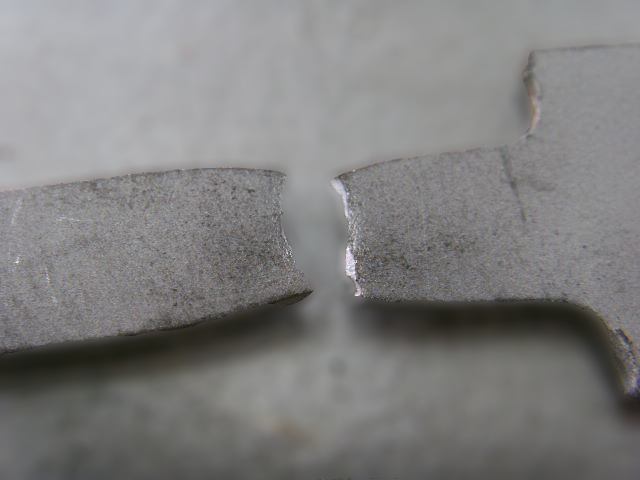
Reading
Further reading
Certification relevance
Measured finished-part material properties are a foundational layer of a certification evidence packet: they verify that production steel matches the design basis and anchor the interpretation of the component tests the claims rest on.
Testing provides evidence; it does not itself certify a product. Certification is a separate function.
Questions engineers ask
Frequently asked questions
Why test finished parts when the mill certificate already lists the steel properties?
The mill certificate describes the coil or plate as it left the producer. Roll forming, punching, welding, and cold work can change strength and ductility in the finished component, so the part may no longer behave the way the certificate suggests. Tensile testing of coupons from finished parts measures the properties the structure actually relies on.
Does a tensile test tell me how much load a rack column can carry?
No. A tensile test measures material properties such as yield strength, tensile strength, and elongation. Member and connection capacity depend on geometry, load path, and stability as well as material, which is why stub column and component tests exist as separate evaluations.
Which standards apply to material tensile testing for rack components?
Tensile testing of steel is typically performed under ASTM A370 or ASTM E8/E8M. The measured properties support design and testing under rack standards such as ANSI MH16.1 and ANSI MH16.3, where component test results are interpreted relative to material properties.
How many tensile coupons does a test program need?
It depends on what the results must support. Qualifying a supplier, interpreting a component test program, and periodic production checks each call for different sampling — and the sampling requirements come from the applicable material or product specification, or from the project requirement, not from the test method. ASTM A370 defines how the mechanical tests are performed and how specimens are prepared; it does not set how many samples a program needs. Scoping starts from the decision the data will feed, not from a fixed count.
What does a material tensile test report include?
The report identifies each specimen and where it was taken from, states the measured yield strength, tensile strength, and elongation, and compares those values to the specified minimums for the material. Stress–strain records are included so a reviewing engineer can see the behavior behind the summary numbers, and traceability information connects each result to the physical coupon that produced it.
Is stronger steel automatically better for a rack component?
Not necessarily. Cold work can raise strength while reducing ductility and narrowing the margin between yield and ultimate strength, and design methods rely on that margin. Measured tensile data shows both sides — strength and ductility — which is why the full stress–strain behavior matters, not just the peak value.
Does imported steel have to be retested in the United States?
Not necessarily. Country of origin does not by itself decide the question: building codes accept material whose properties are established by identification and documentation tied to a recognized specification, and when that evidence holds, additional testing may not be necessary. Testing enters when the evidence is missing, incomplete, not accepted by the reviewing authority, or no longer describes the product — and some jurisdictions, Los Angeles among them, operate their own more prescriptive acceptance programs. The governing question is whether the evidence establishes the material properties.
Does ASTM A370 say how many samples are required?
No. ASTM A370 establishes the methods for mechanical testing of steel products — how a tension test is run and how the results are determined. The number of samples, where coupons are taken, their orientation, and the acceptance criteria come from the governing material specification, product specification, or project requirement. Scoping a verification program starts from that requirement and from the decision the data must support.
Can testing a finished component replace a missing mill certificate?
It provides a different kind of evidence. A mill test report documents the material at a defined production condition; coupons from a finished component establish the measured properties of the material in that component, after manufacturing. For acceptance questions such as legacy material, unavailable records, disputed properties, or finished-product verification, measured properties from the actual component can establish or supplement the material evidence. Whether they satisfy a specific acceptance requirement is determined by the governing specification or the authority reviewing the project.
Is this the assumption you need checked?
Tell us what you make, what changed, and what you need to know — we’ll confirm whether this test answers your question, or point you to the one that does.