

ASTM E3121
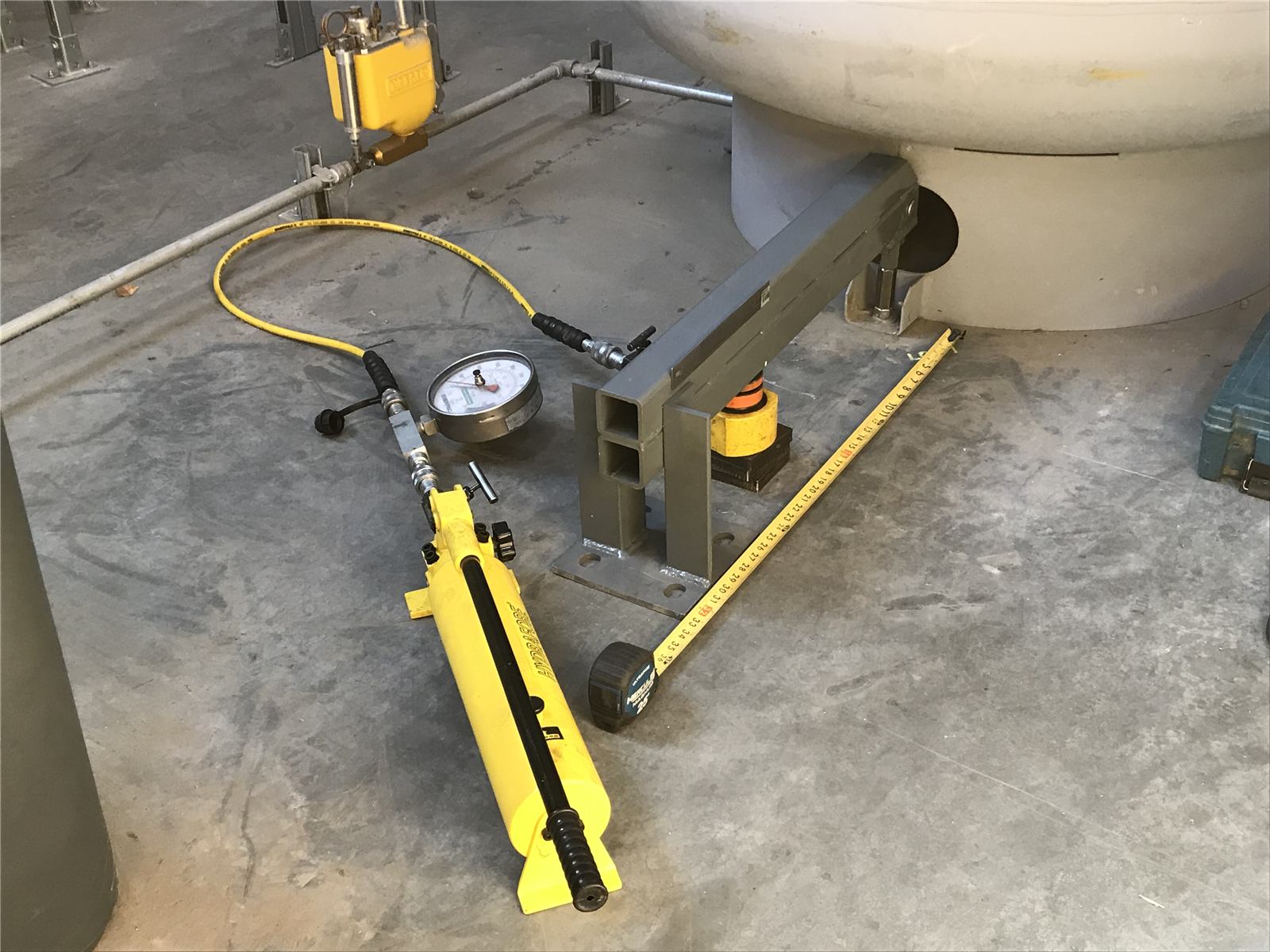
Anchor Proof-Load Testing
Are the installed anchors doing their job?
Testing · Field
Anchors, slabs, concrete strength, and installation quality are assumptions until they are measured. Field testing brings the instruments to the building and turns site conditions into evidence.
Field testing is performed to the stated procedure for each service. It is not covered by the IAS scope of accreditation unless the published scope says so; ask us to confirm.
Five stages — click any to revisit
Why field testing
Every rack calculation ends in the slab: overturning, seismic uplift, and column loads all resolve through anchors into concrete of assumed strength and condition. When the installation was not observed, the drawings are missing, or the slab is older than its documentation, those assumptions are unverified — and field testing is how they become evidence.
The tests below answer different questions — installation quality, anchor capacity, slab behavior, and material strength are separate concerns. Scoping starts by naming which assumption is actually at risk.
Field test types
ASTM E3121
Are the installed anchors doing their job?
ASTM E3121
Can the anchor resist side-loading or horizontal force?
ACI 318 anchorage provisions
Is the slab itself strong enough to resist uplift from the rack system?
ANSI MH16.1
Can the slab support concentrated rack column loads without local damage?
ASTM C42/C42M
What is the actual concrete strength of the slab?
ACI 318 anchorage provisions
Were the anchors tightened to the required installation torque?
ACI 318 anchorage provisions
Do anchors or base plates near control joints or slab edges still behave the way the design assumes?
ANSI MH16.1
Does the installation in the field actually match the design intent?
Concrete cores needed at a site far from the laboratory? SMHE is building a network of local field providers who extract cores near the site and ship them here for testing. Field Sampling Network
Distinctions that matter
Anchor pull vs. slab uplift. An anchor pull test checks whether the anchor connection resists tension. A slab uplift test checks whether the slab resists uplift transferred through the anchorage pattern. They can look similar from a distance; they answer different engineering questions.
Torque check vs. load test. Torque confirms installation tightening. A load test applies force and measures behavior. Torque is an installation check; load testing is performance evidence.
Concrete strength vs. slab behavior. A core test measures material strength. A slab uplift or downforce test evaluates how the slab behaves as a structural system. A strong core does not automatically answer every slab question.
Common questions
They are different questions. An anchor proof-load test checks whether the anchor connection can resist tension; a slab uplift test checks whether the slab system can resist uplift transferred through the anchorage pattern. A perfect anchor does not solve a weak slab, so the first scoping step is deciding which question is actually being asked.
No. A torque check answers whether an anchor was tightened; a proof-load test answers whether it can resist load. Both are useful installation evidence, but torque does not measure pull-out resistance.
When the uncertainty lives in the field, not the product: unobserved installations, undocumented slabs, unknown concrete strength, edge and joint conditions, or an official asking for evidence. Field testing replaces those site-specific assumptions with measured data.
Tell us the site condition you can’t document — unobserved anchors, an unknown slab, missing drawings — and we’ll scope the field test that answers it.