

Field testing · Test type
Concrete Core Strength Testing
Customer questionWhat is the actual concrete strength of the slab?
The short answer
What this test tells you
When nobody knows how strong your concrete floor actually is, every calculation that depends on it is a guess. Core testing answers the question directly: small cylindrical samples are drilled from the slab, tested in a laboratory press, and the holes are patched. You get measured concrete strength at the sampled locations — a real number that replaces an assumption in anchor capacity and floor evaluations. This matters most in older buildings, buildings without drawings, or before a rack upgrade that leans on the floor’s strength. Measured beats assumed when the decision depends on it.
Why it matters
What decision does the result support?
Anchor capacities and slab evaluations are calculated from an assumed concrete strength. If the real strength is lower than assumed, every capacity built on that number is overstated; if it is higher, the evaluation may be unnecessarily conservative. Concrete strength should not be guessed when it controls the decision.
What the evidence supports
- engineering review
- retrofit/due-diligence decisions
- plan check response
- seismic evaluation
Typical project situations
- Existing buildings with missing or incomplete drawings
- Retrofit or rack-upgrade projects where anchorage capacity depends on concrete strength
- Establishing measured strength before slab uplift or downforce evaluation
- Due-diligence review of a facility before purchase or re-racking
- Resolving uncertainty about slab quality or age
- Providing measured inputs for engineering calculations
What you receive
Test reports
The primary deliverable is the test report: what was tested, to which reference, with what instrumentation, what was measured, and what the result means for the assumption in question. What a test report contains is described on the Test reports page.
Important distinctions
What does this test not prove?
A core test measures concrete material strength; it does not evaluate slab behavior. Slab uplift and downforce tests evaluate how the slab performs as a structural system — thickness, reinforcement, subgrade, and joints all participate — and a strong core does not automatically answer those questions. Core results also represent the sampled locations; they inform, but do not replace, engineering judgment about variability across a large slab.
The question is not simply whether something held load. The question is whether the assumptions behind the design remain valid — and every test answers only the question it was designed to ask.
Whether this method is inside SMHE Lab’s accredited scope is stated in the Scope of Accreditation. Ask us to confirm before relying on an accredited result.
The assumption
What assumption does this test check?
The concrete compressive strength assumed in anchorage and slab calculations matches the strength actually present in the slab.
What it evaluates
What does this test evaluate?
Concrete core testing extracts physical samples from the slab and tests them in compression to determine in-place concrete strength. It replaces an assumed design value with a measured one. This matters most when design documents are missing, the slab’s age or history is unknown, or an assumed strength controls an engineering decision about anchorage or slab capacity.
Technical detail
How does the test work?
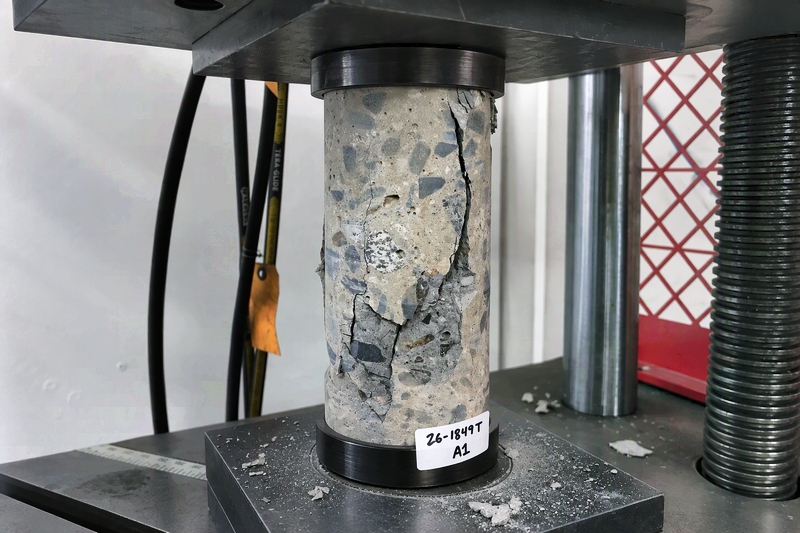
Core testing measures in-place concrete strength directly: cylindrical samples are drilled from the slab at engineered locations, prepared, and tested in compression in the laboratory. Coring locations are selected to represent the areas whose strength actually controls the engineering decision — anchor groups, high-load bays, regions of visible distress or suspected variability — while avoiding embedded reinforcement where practical. Each core’s location, orientation, dimensions, and condition are documented before compression testing; the laboratory result is a measured compressive strength for each sample. SMHE documents the specimen condition, preparation, test setup, and measured result so the data can be evaluated for its intended use. The extracted quantity replaces the assumed design strength in every calculation that depends on it: anchor capacities under ACI 318 anchorage provisions, slab bearing and uplift evaluations, and retrofit feasibility all inherit the measured value instead of a guess. The deliverable ties each measured strength to its sampled location and compares the population against the strength the design assumed, with the engineering implication stated: whether the assumption is confirmed, conservative, or overstated. Core results characterize the sampled locations; extending them across a large slab remains an engineering judgment the report supports rather than replaces. Core holes are patched after sampling, and the field intrusion is small relative to the uncertainty it removes.
Related assumptions
The assumptions on the line
In-place concrete strength
The in-place concrete strength equals or exceeds the value the design assumed.
When drawings are missing or the slab predates its records, an assumed strength becomes the quiet foundation of every anchorage calculation above it.
Related standards
Related standards
ASTM C42/C42M
Related reference. Results are reported as measured test information unless the project scope establishes a specific standard, procedure, or acceptance criterion.
Evidence visuals
What the setup and the numbers look like
Questions engineers ask
Frequently asked questions
Why test concrete cores instead of assuming a design strength?
Because anchor capacities and slab evaluations are calculated from the assumed concrete strength, and if the real strength is lower, every number built on it is overstated. Core testing replaces the assumption with a measured value. Concrete strength should not be guessed when it controls the decision.
Does a core test tell you whether the slab can support the rack?
No — it tells you the material strength of the concrete at the sampled locations. Whether the slab can resist uplift or concentrated column loads is a slab behavior question, evaluated through slab uplift or downforce testing and engineering analysis. Core results are an input to that evaluation, not the answer to it.
When is concrete core testing typically needed?
When design documents are missing, the slab’s age or history is unknown, or an assumed strength controls an anchorage or slab capacity decision. It is common in existing buildings, retrofit projects, and rack upgrades where the original construction records cannot be relied on.
How many cores are taken, and where?
The sampling plan is engineering-driven: enough cores to represent the areas whose strength controls the decision — anchor groups, high-load regions, areas of suspected variability — as the evaluating engineer defines. More cores narrow uncertainty; the right number depends on what the decision is worth and how variable the slab appears.
Does core drilling harm the slab?
The holes are small relative to the slab, located to avoid critical reinforcement and load points where practical, and patched after sampling. The information gained — a measured strength replacing a guessed one — almost always outweighs the localized and repaired intrusion.
What does a core test report contain?
Each core’s location, dimensions, and condition tied to its measured compressive strength, plus a comparison of the results against the strength the design assumed. The useful part is the comparison: it states whether the assumption is confirmed, conservative, or overstated, which is what the engineering decision actually needs. Results are reported as measured test information unless the project scope establishes a specific standard, procedure, or acceptance criterion.
Is this the assumption you need checked?
Tell us about the installation or site condition, what changed, and what you need to know — we’ll confirm whether this test answers your question, or point you to the one that does.