

Field testing · Test type
Anchor Proof-Load Testing
Customer questionAre the installed anchors doing their job?
The short answer
What this test tells you
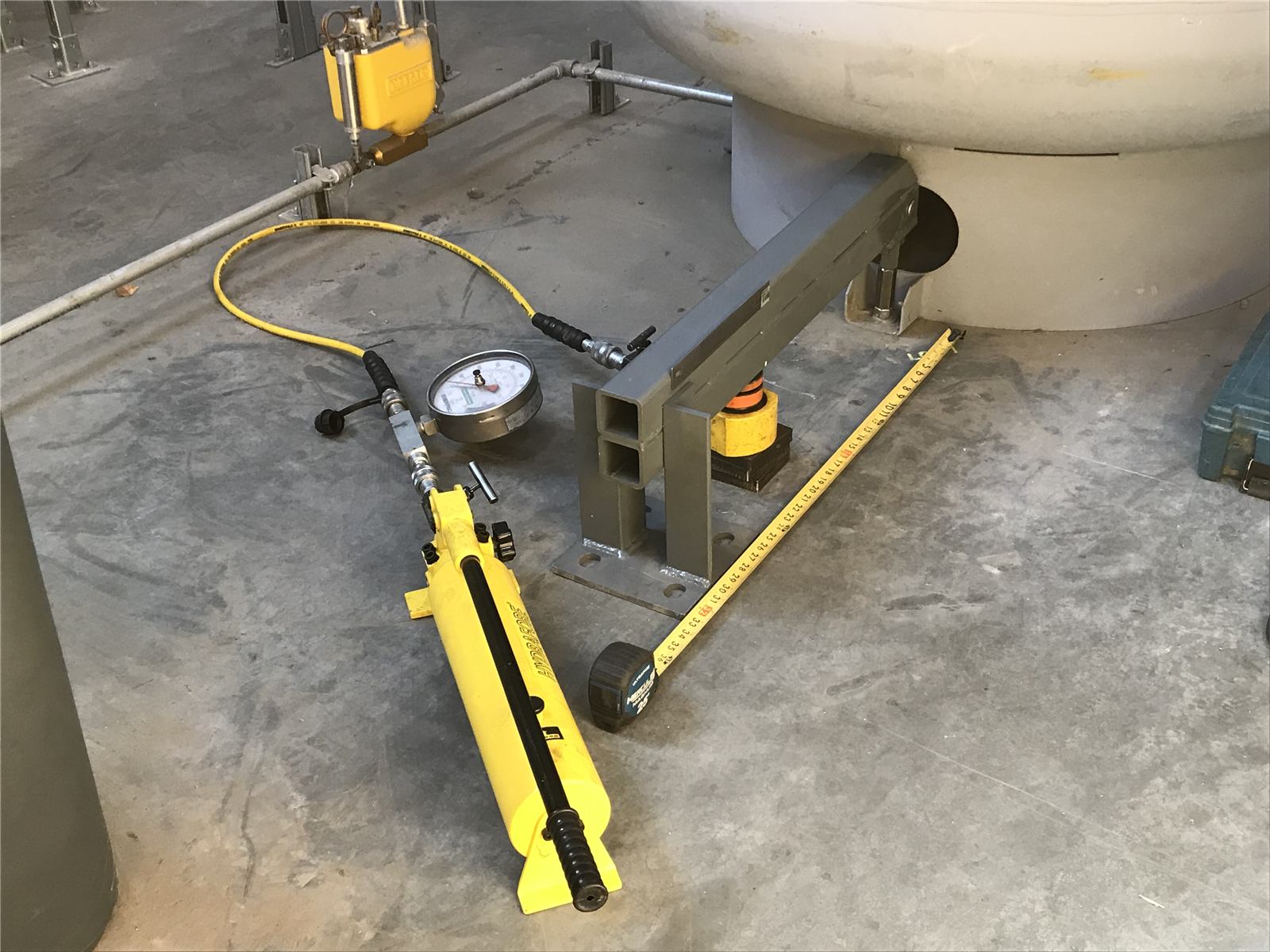
A technician attaches a calibrated pulling device to each selected anchor and applies a defined tension load — the force the engineering design says that anchor must resist. The anchor either holds without moving excessively, or it does not. Either way, you get a documented, per-anchor record you can hand to an engineer, inspector, or building official. This is how an assumption — that the anchors were installed correctly — becomes evidence. It is most valuable when nobody observed the installation, the slab is older, or a permit requires proof that the anchorage performs as designed. Tested anchors remain in service.
Why it matters
What decision does the result support?
The anchor is the link between the rack and the slab. If that connection cannot resist its assumed tension demand, the rack system cannot be treated as performing as designed, and calculated overturning and seismic resistance lose their basis. Proof-load testing turns an installation assumption into documented evidence.
What the evidence supports
- field installation verification
- special inspection documentation
- plan check response
- engineering review
- seismic evaluation
Typical project situations
- Verifying anchors installed without full inspection observation
- Responding to a plan check or building official request for anchorage evidence
- Confirming anchorage as part of a rack permit or seismic retrofit
- Evaluating anchors in older or undocumented slabs
- Supporting special inspection documentation
- Spot-checking anchor installation quality across a large facility
What you receive
Test reports
The primary deliverable is the test report: what was tested, to which reference, with what instrumentation, what was measured, and what the result means for the assumption in question. What a test report contains is described on the Test reports page.
Important distinctions
What does this test not prove?
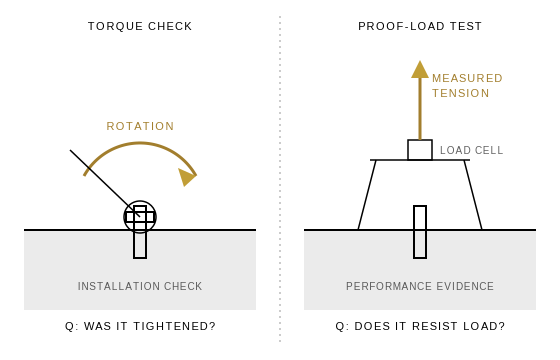
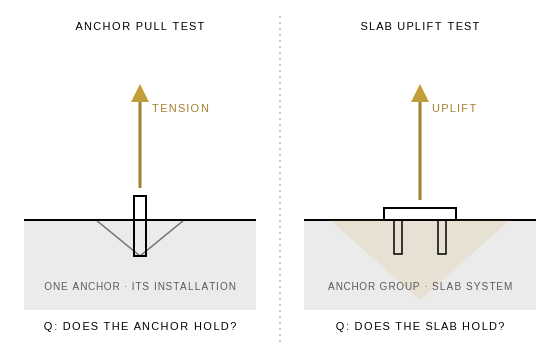
A proof-load test answers whether an anchor can resist load; a torque check only answers whether an anchor was tightened. Torque verification can confirm proper engagement, but it does not measure pull-out resistance. A proof-load test is also different from a slab uplift test: proof-loading evaluates the anchor connection, while slab uplift testing evaluates whether the slab itself can resist uplift transferred through the anchorage pattern. Proof-loading to a defined level also does not establish ultimate capacity — it demonstrates resistance at the proof load.
The question is not simply whether something held load. The question is whether the assumptions behind the design remain valid — and every test answers only the question it was designed to ask.
Whether this method is inside SMHE Lab’s accredited scope is stated in the Scope of Accreditation. Ask us to confirm before relying on an accredited result.
The assumption
What assumption does this test check?
The installed anchors can resist the tension demand assumed in the rack anchorage design.
What it evaluates
What does this test evaluate?
Anchor proof-load testing applies a controlled tension load to installed anchors and observes their response. The test verifies that each tested anchor can resist a defined pull-out force without excessive displacement or loss of engagement. It is especially useful when the installation was not fully observed, the concrete condition is uncertain, or an inspector or engineer needs evidence that the anchorage performs as assumed.
Technical detail
How does the test work?
An anchor proof-load test applies controlled tension to an installed anchor through a reaction fixture that bears on the slab clear of the anchor’s influence zone, so the anchor — not the surrounding setup — is what resists the load. A calibrated hydraulic ram with a load cell or calibrated gauge applies and measures the tension; anchor displacement is monitored where the acceptance basis calls for it. Loading proceeds to a defined proof level and is held per the protocol ASTM E3121 defines, with the anchor observed for excessive displacement, loss of engagement, or concrete distress. The proof load itself is an engineering input: the engineer of record derives it from the design tension demand before the crew mobilizes, so acceptance is tied to the design rather than improvised in the field. The deliverable is a per-anchor record — location against the anchor schedule, applied proof load, hold behavior, observed response, and result against the stated acceptance basis, with equipment calibration referenced. That record converts an installation assumption into documented evidence: the design’s uplift path is defensible at the tested anchors because each one demonstrably resisted its proof load in the concrete that actually exists. It does not establish ultimate capacity; it demonstrates resistance at the proof level while leaving the anchor serviceable.
Related assumptions
The assumptions on the line
Anchor tension capacity
The installed anchors can resist the tension demand assumed in the anchorage design.
Unobserved installation, uncertain concrete, or the wrong anchor type leaves the design’s uplift path resting on hardware no one has loaded.
Installation matches design intent
Anchors and connections were installed as the drawings and product instructions require.
Embedment, torque, spacing, and position drift in the field; the drawings stay correct while the installation quietly diverges from them.
Related standards
Related standards
ASTM E3121ASTM E488ACI 318 anchorage provisionsANSI MH16.1
We test to the reference the standard defines — not to convenience.
Evidence visuals
What the setup and the numbers look like
Reading
Further reading
Reading on this assumption
From the publications archive
Published articles live in the Knowledge Center; shorter notes in the publications archive.
Questions engineers ask
Frequently asked questions
What does an anchor proof-load test prove?
It demonstrates that an installed anchor can resist a defined tension load without excessive displacement or loss of engagement. That converts the assumption that the anchor was installed correctly into documented evidence an engineer or building official can rely on.
How is a proof-load test different from a torque check?
A torque check answers whether an anchor was tightened; a proof-load test answers whether it can resist load. Torque can confirm proper engagement, but it does not measure pull-out resistance. When the question is capacity rather than tightening, proof-load testing is the appropriate check.
Does a proof-load test measure the anchor’s ultimate capacity?
No. A proof-load test demonstrates resistance at a defined proof level without damaging the anchor, which is usually the goal for hardware that will remain in service. Establishing ultimate capacity requires loading to failure, which is a different test with different consequences for the anchor.
How many anchors are proof-load tested in a typical program?
There is no fixed count — the sample is set by the engineer of record or building official based on the anchor population, how consistent the installation appears, and what the evidence must support. A uniform installation may justify sampling, while uncertain installation history or critical anchors may call for testing every anchor in scope. The sampling basis is defined before testing begins so the results mean what they claim.
What does an anchor proof-load report contain?
A per-anchor record: location keyed to an anchor schedule or plan, the applied proof load and hold behavior, the observed response, and the result against a stated acceptance basis, with equipment calibration referenced. The report also states where the proof load came from — the design tension demand — so an engineer or official can see the acceptance logic, not just pass and fail marks.
What happens if an anchor fails its proof load?
The failure is documented as a finding and routed to the engineer of record — it is information, not just a bad mark. Depending on the cause, the resolution may be replacing or supplementing the anchor, testing adjacent anchors to bound the extent of the issue, or revisiting the anchorage design for the affected area. A failed proof load found in a test program is far cheaper than the same failure found by an earthquake.
Is this the assumption you need checked?
Tell us about the installation or site condition, what changed, and what you need to know — we’ll confirm whether this test answers your question, or point you to the one that does.