

Field testing · Test type
Slab Uplift Proof-Load Testing
Customer questionIs the slab itself strong enough to resist uplift from the rack system?
The short answer
What this test tells you
Anchors can be perfect and the floor can still be the weak link. This test pulls upward on the slab through the same anchor pattern your racks use, and measures how the floor responds. You find out whether the slab itself — its thickness, reinforcement, and condition — can resist the uplift forces a seismic event or a tall rack design would put into it. That is a different question from whether an anchor holds, and it matters most when the building is older or its construction records are missing. The documented result supports engineering reviews, seismic evaluations, and permit requirements.
Why it matters
What decision does the result support?
A perfect anchor does not solve a weak slab. If the slab cannot resist the uplift demand from a high-uplift or seismic rack design, anchor capacity numbers alone overstate the anchorage system. Evaluating slab behavior directly keeps the uplift load path assumption defensible from the base plate down.
What the evidence supports
- engineering review
- seismic evaluation
- plan check response
- retrofit/due-diligence decisions
- special inspection documentation
Typical project situations
- High-uplift or seismic rack designs on slabs with uncertain reinforcement
- Existing buildings where slab construction records are missing
- Field verification requested by an engineer of record or building official
- Retrofit or rack-upgrade projects that increase uplift demand
- Separating slab questions from anchor questions when anchorage behavior is in doubt
What you receive
Test reports
The primary deliverable is the test report: what was tested, to which reference, with what instrumentation, what was measured, and what the result means for the assumption in question. What a test report contains is described on the Test reports page.
Important distinctions
What does this test not prove?
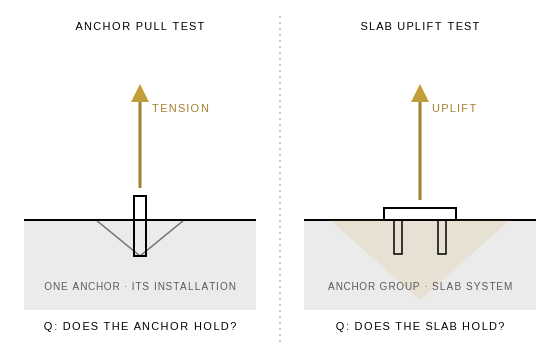
An anchor pull test checks whether the anchor connection can resist tension; a slab uplift test checks whether the slab system can resist uplift transferred through the rack anchorage pattern. They may look similar in the field, but they answer different engineering questions. Slab uplift testing also does not measure concrete material strength — a core test does that — and a strong core does not automatically answer how the slab behaves as a system under uplift.
The question is not simply whether something held load. The question is whether the assumptions behind the design remain valid — and every test answers only the question it was designed to ask.
Whether this method is inside SMHE Lab’s accredited scope is stated in the Scope of Accreditation. Ask us to confirm before relying on an accredited result.
The assumption
What assumption does this test check?
The slab can resist the uplift force transferred through the rack anchorage pattern, not merely that individual anchors hold.
What it evaluates
What does this test evaluate?
Slab uplift proof-load testing applies upward load through a representative anchorage pattern and evaluates how the slab system responds. It is different from a simple anchor pull test: the concern is not whether a single anchor is holding, but whether the slab — its thickness, reinforcement, and condition — can resist the uplift demand the rack design transfers into it. The test helps separate anchor performance from slab performance so the right engineering question is being answered.
Technical detail
How does the test work?
Slab uplift proof-load testing loads the slab in the upward direction through a representative anchorage pattern, so the specimen is the slab system — thickness, reinforcement, and condition — rather than an individual anchor. A reaction frame or bridge spans the loaded group, bearing far enough away that the reaction does not artificially clamp the region being evaluated. A calibrated ram and load cell apply tension through the anchorage pattern the rack design actually uses, and displacement instrumentation monitors slab movement so the response can be read as behavior, not just survival. Loading proceeds in controlled steps to a proof level derived from the design uplift demand, with holds and observations per the program the engineer of record establishes. The extracted result is the slab’s load–displacement response and its condition at the proof load: whether the uplift demand the rack design transfers into the floor is resisted without distress, cracking, or displacement inconsistent with the design assumption. The deliverable documents the tested pattern, load steps, instrumentation, response curves, and observations, giving the engineer direct evidence for the uplift load path from base plate to slab — the link that anchor capacity numbers alone cannot demonstrate. It answers the slab question separately from the anchor question, which is precisely what makes it useful when the two have been conflated.
Related assumptions
The assumptions on the line
Slab uplift resistance
The slab system can resist the uplift forces transferred through the rack anchorage pattern.
A perfect anchor does not fix a weak slab — reinforcement, thickness, and condition are often assumed from age-of-building defaults, not documents.
In-place concrete strength
The in-place concrete strength equals or exceeds the value the design assumed.
When drawings are missing or the slab predates its records, an assumed strength becomes the quiet foundation of every anchorage calculation above it.
Related standards
Related standards
ACI 318 anchorage provisionsANSI MH16.1
Evidence visuals
What the setup and the numbers look like
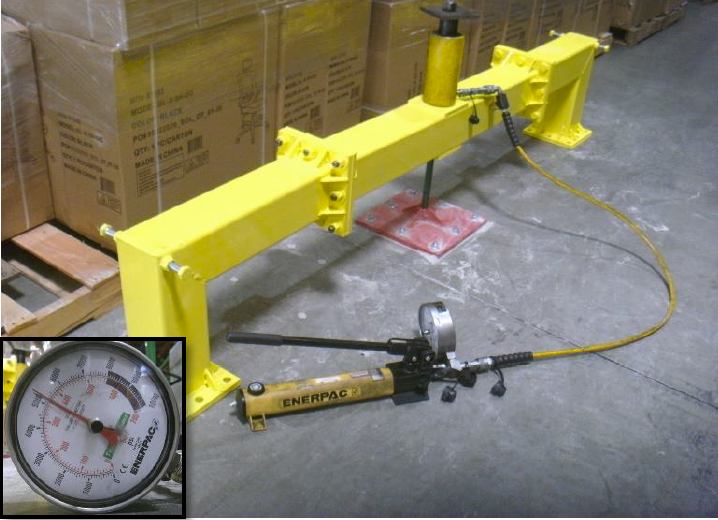
Reading
Further reading
Reading on this assumption
From the publications archive
Published articles live in the Knowledge Center; shorter notes in the publications archive.
Questions engineers ask
Frequently asked questions
How is a slab uplift test different from an anchor pull test?
An anchor pull test checks whether the anchor connection can resist tension. A slab uplift test checks whether the slab itself can resist uplift transferred through the rack anchorage pattern. They can look similar in the field, but they answer different engineering questions — a perfect anchor does not solve a weak slab.
When is slab uplift testing needed?
It is most useful when uplift demand is high — seismic designs and tall or narrow rack configurations — and the slab’s reinforcement, thickness, or condition is uncertain. In those cases anchor capacity alone does not establish the uplift load path, because the slab has to resist the force the anchors deliver into it.
Does a strong concrete core mean the slab will resist uplift?
Not necessarily. A core test measures concrete material strength, while an uplift test evaluates slab behavior as a system, where thickness, reinforcement, and condition all participate. Strong concrete in a thin or lightly reinforced slab can still leave uplift resistance short of the design assumption.
How are slab uplift test locations selected?
Locations are selected to represent the governing combination of demand and uncertainty: the anchorage patterns carrying the highest design uplift, and the slab regions where thickness, reinforcement, or condition is least known. The intent is to test where the assumption is most exposed, so a passing result carries real engineering weight across the layout.
Does slab uplift proof-load testing damage the floor?
The test is run as a proof-load evaluation: load is applied in controlled steps to a level derived from the design demand, with displacement monitored so loading can stop before distress develops. The goal is evidence that the slab resists the demand, not a failure test — a slab that passes remains in service.
How do slab uplift results get used in plan check or permitting?
The report documents the tested anchorage pattern, load steps, displacement response, and observations in a form an engineer of record can cite and a building official can file. It typically supports the uplift load path portion of a seismic or permit review — the link between anchor capacity numbers and the floor those anchors load.
Is this the assumption you need checked?
Tell us about the installation or site condition, what changed, and what you need to know — we’ll confirm whether this test answers your question, or point you to the one that does.