

Field testing · Test type
Anchor Shear Testing
Customer questionCan the anchor resist side-loading or horizontal force?
The short answer
What this test tells you
Not every force on an anchor pulls straight up — earthquakes and impacts push racks sideways, and the anchors have to resist that sliding force too. In this test, a technician applies a controlled horizontal load to an installed anchor and measures how it responds. You learn whether the anchors can resist the sideways forces the design assumes, in the actual concrete, at the actual locations — including spots near slab edges or joints where resistance can be lower. The documented result supports engineering reviews, seismic evaluations, and building department questions about the lateral strength at the base of your racks.
Why it matters
What decision does the result support?
Rack anchorage design assumes the anchors resist both tension and shear. If shear resistance is lower than assumed — because of concrete condition, edge proximity, installation quality, or anchor type — the lateral load path at the base of the rack is not what the calculation assumed. Verifying shear behavior keeps seismic and impact-related design assumptions grounded in evidence.
What the evidence supports
- engineering review
- seismic evaluation
- plan check response
- field installation verification
- retrofit/due-diligence decisions
Typical project situations
- Evaluating anchorage for racks with significant seismic base shear
- Investigating anchors near slab edges or joints where shear resistance is uncertain
- Assessing anchor behavior where impact loading is a concern
- Supporting engineering review of lateral load paths at the rack base
- Verifying shear assumptions for anchor types or slab conditions without documented data
What you receive
Test reports
The primary deliverable is the test report: what was tested, to which reference, with what instrumentation, what was measured, and what the result means for the assumption in question. What a test report contains is described on the Test reports page.
Important distinctions
What does this test not prove?
Shear testing evaluates resistance to horizontal load; it does not answer whether the anchor can resist tension, and it does not evaluate the slab’s uplift or bearing behavior. It should not be confused with a proof-load test, which pulls the anchor in tension, or with a torque check, which only confirms tightening. Because shear resistance is sensitive to edge distance and joint proximity, a result at one location does not automatically apply to anchors placed near edges or control joints.
The question is not simply whether something held load. The question is whether the assumptions behind the design remain valid — and every test answers only the question it was designed to ask.
Whether this method is inside SMHE Lab’s accredited scope is stated in the Scope of Accreditation. Ask us to confirm before relying on an accredited result.
The assumption
What assumption does this test check?
The installed anchorage can resist the horizontal shear demand assumed in the design, not only tension.
What it evaluates
What does this test evaluate?
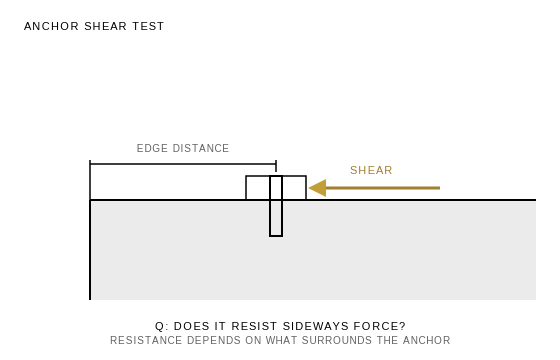
Anchor shear testing applies load parallel to the slab surface to evaluate how an installed anchor behaves when the force pushes or slides rather than pulls. In storage rack applications, horizontal demand can come from seismic loading, impact, or load transfer through the frame into the base. The test evaluates whether the anchor connection can resist that lateral demand under the conditions that actually exist in the slab.
Technical detail
How does the test work?
Anchor shear testing loads an installed anchor parallel to the slab surface, replicating the direction in which seismic base shear, impact, or frame action actually pushes the anchorage. A shear fixture engages the anchor or a representative base-plate condition and reacts against the slab away from the test location; a calibrated ram and load cell apply and measure the horizontal force, and displacement is monitored so load–slip behavior can be observed rather than only a peak value. Loading proceeds per the protocol ASTM E3121 defines, either to a defined proof level or, where the engineering question requires it, further to characterize behavior. Because shear resistance depends heavily on what surrounds the anchor near the surface, test locations are chosen deliberately: mid-slab, edge-adjacent, and joint-adjacent positions are different tests answering different questions, and the report records exactly which condition was tested. The deliverable documents each location and its geometry relative to edges and joints, the applied load history, the displacement response, and observed distress in the anchor or surrounding concrete. The result gives the engineer a defensible basis for the lateral load path at the rack base — either confirming that the design shear demand is resisted, or quantifying how far a specific installed condition falls from the assumption.
Related assumptions
The assumptions on the line
Anchor shear capacity
The anchorage can resist the horizontal shear demand the design routes into the slab.
Shear resistance is sensitive to edge distance, joints, and concrete condition — a value that held in the middle of a slab may not hold near its edge.
Edge and joint proximity
Anchors sit far enough from slab edges and control joints for their assumed capacities to apply.
Layouts move during installation; an anchor a few inches from a joint can lose a large share of the capacity the table assumed for it.
Related standards
Related standards
ASTM E3121ASTM E488ACI 318 anchorage provisionsANSI MH16.1
We test to the reference the standard defines — not to convenience.
Evidence visuals
What the setup and the numbers look like
Questions engineers ask
Frequently asked questions
Why would an anchor need shear testing instead of a pull test?
Because not every force pulls straight up. Rack systems can push anchors sideways through seismic loading, impact, or load transfer through the frame, and a tension pull test does not evaluate that horizontal load path. Shear testing applies the load in the direction the concern actually acts.
Does a passing tension test mean the anchor is fine in shear?
No. Tension and shear resistance depend on different mechanisms, and shear behavior is especially sensitive to edge distance, joint proximity, and concrete condition near the surface. An anchor can perform well in tension and still have reduced shear resistance at a particular location.
When does anchor shear testing make sense for rack systems?
It makes sense when horizontal demand is significant and the shear assumption is uncertain — for example, seismic base shear on anchors near slab edges or control joints, or anchor types without documented shear data in the existing slab. The goal is verifying that the lateral load path at the rack base behaves the way the design assumes.
How are anchor shear test locations chosen?
Locations are chosen to represent the conditions that govern the engineering question: mid-slab anchors establish the baseline, while anchors near slab edges, control joints, or visible cracks are tested because that is where shear resistance is most likely to fall below the assumption. Each result is tied to the condition it was tested in, so the program brackets the conditions that actually exist in the layout.
What does an anchor shear test report include?
It documents each test location and its geometry relative to edges and joints, the applied load history, the measured displacement response, and any observed distress in the anchor or surrounding concrete. Recording the geometry matters because a shear result is location-specific — the report states which installed condition each result represents.
Why field-test shear instead of relying on the anchor manufacturer’s published values?
Published shear capacities assume the conditions the qualification testing used — sound concrete, adequate edge distance, correct installation. A field test evaluates the anchor in the slab that actually exists, at the location that actually matters, which is the question a catalog value cannot answer when edges, joints, or concrete condition are in play.
Is this the assumption you need checked?
Tell us about the installation or site condition, what changed, and what you need to know — we’ll confirm whether this test answers your question, or point you to the one that does.