

Field testing · Test type
Slab Downforce / Punching-Type Testing
Customer questionCan the slab support concentrated rack column loads without local damage?
The short answer
What this test tells you
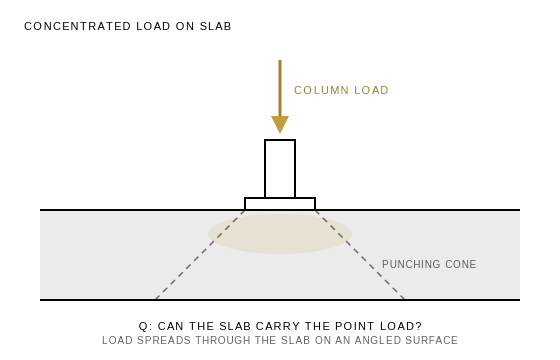
A loaded rack column pushes a surprisingly large force through a small steel plate into your floor. This test recreates that condition: a controlled vertical load is applied to the slab through a representative bearing plate, and instruments measure how the floor responds. You find out whether the slab can support the concentrated loads your racks — or the heavier racks you are planning — will actually place on it, without cracking or local damage. It is the right check before increasing storage density, changing layouts, or buying a building whose floor records are missing. Rack capacity starts at the floor.
Why it matters
What decision does the result support?
Rack capacity is not only about steel. If the slab cannot carry the concentrated column reaction, increasing rack capacity on paper does not increase what the system can safely support. Verifying slab behavior under concentrated load keeps layout, loading, and storage-density decisions grounded in the floor’s actual behavior.
What the evidence supports
- engineering review
- retrofit/due-diligence decisions
- plan check response
- special inspection documentation
Typical project situations
- Heavy pallet loads or high-density storage on slabs of uncertain capacity
- Rack layout changes that concentrate load in new locations
- Existing slabs with unknown thickness, reinforcement, or subgrade condition
- Due-diligence evaluation before increasing storage loads
- Investigating slab distress observed near rack base plates
What you receive
Test reports
The primary deliverable is the test report: what was tested, to which reference, with what instrumentation, what was measured, and what the result means for the assumption in question. What a test report contains is described on the Test reports page.
Important distinctions
What does this test not prove?
A downforce test shows how the slab responded at the tested locations and load level; extending that result across a floor remains an engineering judgment. Downforce testing evaluates the slab under concentrated downward load; it is the opposite loading direction from slab uplift testing, and the two answer different questions about the same floor. It is also not a material strength test: a concrete core measures compressive strength of the concrete, while downforce testing evaluates how the slab behaves as a system, where thickness, reinforcement, subgrade support, and joints all participate. A satisfactory core result does not by itself demonstrate adequate slab behavior under concentrated rack reactions.
The question is not simply whether something held load. The question is whether the assumptions behind the design remain valid — and every test answers only the question it was designed to ask.
Whether this method is inside SMHE Lab’s accredited scope is stated in the Scope of Accreditation. Ask us to confirm before relying on an accredited result.
The assumption
What assumption does this test check?
The slab can resist the concentrated downward reaction at rack base plates without local bearing or punching-type distress.
What it evaluates
What does this test evaluate?
Storage rack columns concentrate large loads into relatively small base plate areas. Downforce or punching-type testing applies controlled vertical load to a representative bearing area and evaluates how the slab responds — bearing behavior, local deformation, and any evidence of punching-type distress. It addresses the slab side of the rack capacity question, which the steel design alone does not answer.
Technical detail
How does the test work?
Downforce testing applies controlled vertical load to the slab through a bearing area representative of a rack base plate, evaluating the floor under the concentrated reaction a loaded rack column actually delivers. A reaction system — dead weight, a loaded frame, or reaction points located outside the influence zone — provides the resistance the ram pushes against; a calibrated load cell measures applied force, and displacement instrumentation around the bearing area tracks local deformation of the slab surface. Loading proceeds in controlled steps to a level derived from the design column reaction, with holds and observation per the program the engineer of record defines. The quantities extracted are the load–deformation response at the bearing area, recovery on unload where measured, and any evidence of bearing distress or punching-type behavior — radial cracking, local depression, joint movement. Because slab response under concentrated load depends on thickness, reinforcement, subgrade support, and joint proximity, test locations are chosen to represent the governing conditions in the layout, and the report records what each location represents. The deliverable gives the engineer measured slab behavior at rack-scale point loads — the floor’s side of the capacity question — supporting layout decisions, storage-density increases, and due-diligence evaluations that steel calculations alone cannot resolve.
Related assumptions
The assumptions on the line
Slab bearing under concentrated load
The slab can carry concentrated rack column loads without local distress.
Rack loads concentrate into small base plates; densifying storage or re-racking raises point loads on a floor designed for something else.
In-place concrete strength
The in-place concrete strength equals or exceeds the value the design assumed.
When drawings are missing or the slab predates its records, an assumed strength becomes the quiet foundation of every anchorage calculation above it.
Related standards
Related standards
ANSI MH16.1
Evidence visuals
What the setup and the numbers look like
Questions engineers ask
Frequently asked questions
What does slab downforce or punching-type testing evaluate?
It applies controlled vertical load over a representative bearing area to evaluate whether the slab can support concentrated rack column loads without local damage. It addresses the floor’s side of the rack capacity question, which the steel design alone does not answer.
How is downforce testing different from concrete core testing?
A core test measures the compressive strength of the concrete material. Downforce testing evaluates how the slab behaves as a system under concentrated load, where thickness, reinforcement, subgrade support, and joints all matter. A satisfactory core result does not by itself demonstrate adequate slab behavior under rack reactions.
When should slab downforce behavior be checked?
When rack loads are high or concentrated, when layout changes place columns in new locations, or when the slab’s construction and condition are uncertain. It is also a reasonable due-diligence step before increasing storage density in an existing facility.
How is the test load for a downforce test chosen?
The target derives from the design column reaction — the concentrated load a loaded rack column will actually deliver through its base plate — and is set by the engineer of record, often with a margin appropriate to the decision the test supports. The load level is an engineering decision made before mobilization, not a field improvisation.
Why test the slab instead of just calculating its capacity?
Calculation needs inputs — thickness, reinforcement, concrete strength, subgrade support — and in many existing buildings those inputs are missing or unreliable. A load test measures the slab’s actual behavior as a system, resolving in one measurement what would otherwise require assumptions stacked on assumptions.
If the slab has carried racks for years, does it still need downforce testing before an upgrade?
Service history validates the loads the slab has already seen, not the higher concentrated loads a denser or taller configuration will impose. When an upgrade increases point loads, the floor faces a demand it has never experienced — testing answers the new question directly instead of extrapolating from the old one.
Is this the assumption you need checked?
Tell us about the installation or site condition, what changed, and what you need to know — we’ll confirm whether this test answers your question, or point you to the one that does.