
Field testing · Test type
Anchor Torque Verification
Customer questionWere the anchors tightened to the required installation torque?
The short answer
What this test tells you
After a rack installation, one question is simple but often undocumented: were the anchors actually tightened the way the instructions require? Torque verification answers it. A technician checks each anchor with a calibrated torque wrench and records the result, anchor by anchor, in a log you can hand to an inspector or keep in your installation records. It is an efficient, economical way to document installation for punch lists and inspection records — and an honest one, because the report says what it is: proof of proper tightening, not proof of load capacity. When capacity is the question, a load test is the right tool.
Why it matters
What decision does the result support?
Under-tightened anchors may not develop the engagement or preload the installation instructions assume, and undocumented tightening leaves an open question in inspection records. Torque verification closes that question efficiently. When the concern is capacity rather than tightening, however, torque alone is not the right evidence — preserving that distinction protects everyone who relies on the documentation.
What the evidence supports
- field installation verification
- special inspection documentation
- engineering review
Typical project situations
- Contractor verification after rack installation
- Field inspection documentation for owners or inspectors
- Closing out installation punch lists
- Screening a large anchor population before deciding whether load testing is needed
- Periodic checks after rack reconfiguration
What you receive
Test reports
The primary deliverable is the test report: what was tested, to which reference, with what instrumentation, what was measured, and what the result means for the assumption in question. What a test report contains is described on the Test reports page.
Important distinctions
What does this test not prove?
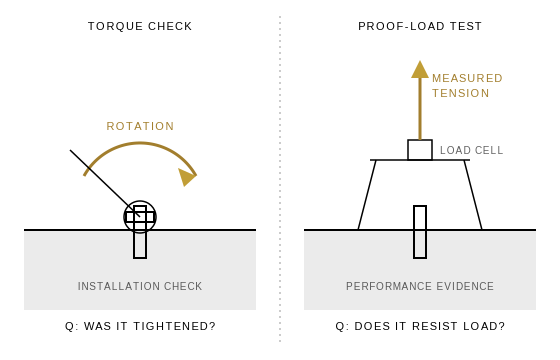
A torque check answers whether an anchor was tightened; a proof-load test answers whether it can resist load. Torque can help confirm engagement, but it does not directly measure pull-out strength, and a passing torque check should never be presented as load-capacity evidence. When an engineer or official needs performance evidence, proof-load or shear testing is the appropriate tool; torque verification is the appropriate tool for documenting installation tightening.
The question is not simply whether something held load. The question is whether the assumptions behind the design remain valid — and every test answers only the question it was designed to ask.
Whether this method is inside SMHE Lab’s accredited scope is stated in the Scope of Accreditation. Ask us to confirm before relying on an accredited result.
The assumption
What assumption does this test check?
The installed anchors were tightened to the torque the installation specification requires.
What it evaluates
What does this test evaluate?
Torque verification checks installed anchors against the required installation torque using a calibrated torque wrench. It confirms whether the tightening step of the installation was completed as specified, which supports proper engagement and preload for many anchor types. It is an installation quality check, and it produces documentation that contractors, inspectors, and owners can reference.
Technical detail
How does the test work?
Torque verification checks installed anchors against their required installation torque using a calibrated torque wrench, documenting whether the tightening step of the installation was completed as the anchor manufacturer’s instructions and the design documents require. The setup is deliberately simple: each anchor in the verification scope is identified against the anchor schedule, the required torque for its type and size is confirmed from the installation specification, and the wrench — with current calibration documented — is applied per the verification approach the program defines. The recorded quantities are per-anchor: location, anchor identification, required torque, verification result, and any anomalies such as spinning anchors, missing hardware, or damaged threads, which are flagged rather than corrected silently. The deliverable is a torque verification log tied to a location plan, with equipment calibration referenced, suitable for special inspection files and installation close-out records. Its engineering value is precisely bounded: for torque-controlled anchor types, verified torque supports the engagement and preload the installation instructions assume — but it is installation-quality evidence, not capacity evidence. The log documents that tightening was done; where the question is what the anchor can resist, proof-load or shear testing supplies that answer. Keeping those two kinds of records distinct protects everyone who relies on them.
Related assumptions
The assumptions on the line
Installation matches design intent
Anchors and connections were installed as the drawings and product instructions require.
Embedment, torque, spacing, and position drift in the field; the drawings stay correct while the installation quietly diverges from them.
Related standards
Related standards
ACI 318 anchorage provisions
Evidence visuals
What the setup and the numbers look like
Questions engineers ask
Frequently asked questions
What does anchor torque verification confirm?
It confirms that installed anchors were tightened to the torque the installation specification requires, using a calibrated wrench. That documents the tightening step of the installation and supports proper engagement for many anchor types.
Is a torque check the same as a load test?
No. A torque check answers whether an anchor was tightened; a proof-load test answers whether it can resist load. Torque is an installation check, and a passing torque check should not be presented as evidence of pull-out capacity.
When is torque verification enough, and when is more testing needed?
Torque verification is appropriate when the question is installation quality and documentation — whether the tightening step was done as specified. When an engineer or official needs performance evidence, or when concrete condition or installation history is uncertain, proof-load or shear testing is the appropriate next step.
What does a torque verification log contain?
A per-anchor record: location keyed to a plan, the required installation torque from the specification, the verification result, and any anomalies — spinning anchors, missing hardware, damaged threads — flagged for follow-up. Equipment calibration is referenced so the log stands up in special inspection files.
What happens when an anchor fails a torque check?
The anchor is documented as a finding, not quietly retightened and passed. Depending on the cause — a spinning anchor, stripped threads, questionable embedment — the resolution ranges from proper retightening to replacement, and a pattern of failures may justify proof-load testing to establish whether the population’s capacity is actually there.
Why is torque verification often the first step across a large anchor population?
Because it screens economically: checking torque across hundreds of anchors quickly identifies where installation quality is consistent and where it is not. That triage lets load testing — which costs more per anchor — concentrate on the locations where the screening raised questions, rather than being spread thin everywhere.
Is this the assumption you need checked?
Tell us about the installation or site condition, what changed, and what you need to know — we’ll confirm whether this test answers your question, or point you to the one that does.