

Field testing · Test type
Control Joint / Edge Proximity Evaluation
Customer questionDo anchors or base plates near control joints or slab edges still behave the way the design assumes?
The short answer
What this test tells you
Rack layouts are planned around storage, not around the sawcut joints in your floor — so base plates routinely end up next to joints and slab edges, where anchors are weaker than the standard tables assume. This evaluation maps exactly where your anchors sit relative to joints, edges, and cracks, and identifies the locations where the usual capacity assumptions no longer apply. You get a clear picture of which anchor locations are fine, which need engineering attention, and which should be load tested — so effort and money go to the spots that actually matter, before they become problems.
Why it matters
What decision does the result support?
Rack layouts are set by storage logic, not joint layout, so base plates routinely land near joints and edges. If proximity effects are ignored, published anchor capacities can overstate what a specific anchor location can actually resist. Identifying affected locations early lets the engineer address them deliberately instead of discovering them through a field problem later.
What the evidence supports
- engineering review
- plan check response
- field installation verification
- retrofit/due-diligence decisions
- seismic evaluation
Typical project situations
- Rack layouts where base plates land on or near control joints
- Anchors placed near slab edges, trenches, or penetrations
- Reviewing anchorage assumptions before a proof-load or shear test program
- Existing facilities where sawcut joint patterns were never mapped against rack rows
- Supporting engineering review of location-specific anchor capacity reductions
What you receive
Test reports
The primary deliverable is the test report: what was tested, to which reference, with what instrumentation, what was measured, and what the result means for the assumption in question. What a test report contains is described on the Test reports page.
Important distinctions
What does this test not prove?
This is an evaluation of installed conditions and their effect on design assumptions, not a load test by itself. It does not measure anchor capacity — proof-load or shear testing does that — and it does not measure concrete strength, which a core test does. Its value is identifying which anchor locations cannot rely on standard capacity assumptions, so that testing and analysis effort goes where it matters.
The question is not simply whether something held load. The question is whether the assumptions behind the design remain valid — and every test answers only the question it was designed to ask.
Whether this method is inside SMHE Lab’s accredited scope is stated in the Scope of Accreditation. Ask us to confirm before relying on an accredited result.
The assumption
What assumption does this test check?
Anchorage capacity assumptions remain valid where anchors or base plates fall near control joints, slab edges, or other discontinuities.
What it evaluates
What does this test evaluate?
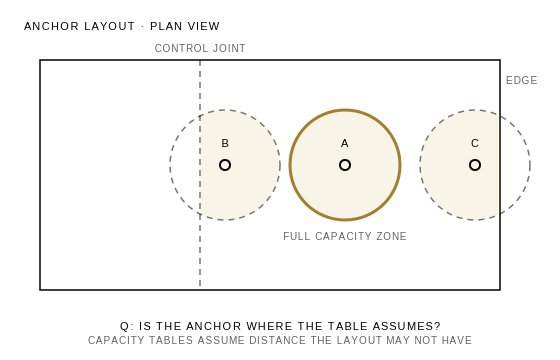
Anchorage calculations generally assume the anchor is surrounded by sound, continuous concrete. Control joints, slab edges, cracks, and other discontinuities interrupt that assumption: they can reduce the concrete available to resist breakout and change how load spreads into the slab. This evaluation documents where anchors and base plates fall relative to joints and edges, assesses which anchorage and slab behavior assumptions are affected, and identifies where analysis or targeted field testing is needed to keep those assumptions defensible.
Technical detail
How does the test work?
This evaluation maps the as-installed geometry that anchorage calculations silently depend on: where each anchor and base plate actually sits relative to control joints, slab edges, construction joints, cracks, and penetrations. The field work combines measurement and documentation — joint and edge locations are surveyed against rack rows, base-plate positions are recorded, and proximity dimensions are measured at the locations that matter. Each condition is then assessed against the geometric assumptions embedded in the anchorage design: ACI 318 anchorage provisions tie breakout and shear capacity to the concrete available around the anchor, and a joint or edge inside that zone changes the calculation’s basis. The deliverable is a mapped evaluation: base-plate locations plotted against joints and edges, each flagged location categorized by which assumption it affects — tension breakout, shear toward an edge, load transfer across a joint — and a recommended resolution: reduced-capacity analysis, relocation or supplemental anchorage, or targeted proof-load or shear testing at the affected locations. The evaluation measures geometry and assesses assumptions; it does not itself measure capacity. Its value is triage — concentrating analysis and testing effort on the locations where standard capacity assumptions cannot be relied on, before those locations surface as field problems under load.
Related assumptions
The assumptions on the line
Edge and joint proximity
Anchors sit far enough from slab edges and control joints for their assumed capacities to apply.
Layouts move during installation; an anchor a few inches from a joint can lose a large share of the capacity the table assumed for it.
Anchor shear capacity
The anchorage can resist the horizontal shear demand the design routes into the slab.
Shear resistance is sensitive to edge distance, joints, and concrete condition — a value that held in the middle of a slab may not hold near its edge.
Related standards
Related standards
ACI 318 anchorage provisions
Evidence visuals
What the setup and the numbers look like
Questions engineers ask
Frequently asked questions
Why do control joints and slab edges matter for anchors?
Anchorage calculations generally assume the anchor is surrounded by sound, continuous concrete. A joint or edge interrupts that concrete, reducing the material available to resist breakout and changing how load spreads into the slab. An anchor next to a joint is, in effect, a different anchor than the same product installed mid-slab.
Is this evaluation a load test?
No. It is an evaluation of installed conditions and their effect on design assumptions — it identifies which anchor locations cannot rely on standard capacity assumptions. Where capacity needs to be demonstrated, it is typically followed by targeted proof-load or shear testing at the affected locations.
What happens if base plates were installed over control joints?
The affected locations are documented and flagged for engineering review, since published anchor capacities may not apply there. Depending on the situation, the engineer may reduce the assumed capacity, relocate or supplement the anchorage, or call for field testing to establish what the specific location can resist.
When in a project should a joint and edge proximity evaluation happen?
The most economical time is before or during installation, when a base plate can still be shifted a few inches at no real cost. In existing facilities it belongs at the front of an anchorage evaluation — before a proof-load or shear program — so testing effort is aimed at the locations the geometry actually puts in question.
What does the evaluation deliverable look like?
A mapped summary: base-plate and anchor locations plotted against joints, edges, and cracks, with each flagged location categorized by the assumption it affects and a recommended resolution — reduced-capacity analysis, relocation or supplemental anchorage, or targeted testing. It is a triage document built for the engineer of record to act on.
Does every anchor near a joint need to be load tested?
No. Many flagged locations are resolved by analysis — the engineer applies the reduced capacity the geometry implies and confirms the design still works. Testing is reserved for locations where the reduced assumption does not clearly hold, which is exactly the economy the evaluation exists to create.
Is this the assumption you need checked?
Tell us about the installation or site condition, what changed, and what you need to know — we’ll confirm whether this test answers your question, or point you to the one that does.