

Lab testing · Test type
Arm-to-Column Connection Testing
Customer questionCan the arm connection on our cantilever rack carry the load our catalog says it can?
The short answer
What this test tells you
Everything you store on a cantilever rack arm passes through one connection into the column. This test loads your actual arm-and-column combination in a controlled fixture and measures what that connection really carries and how much it moves under load. The result tells you whether the capacity printed in your catalog stands on measured behavior — and gives your engineers and your customers a documented basis for it. If you are changing the connector, the column thickness, or the material, the same test shows whether the published rating still holds.
Why it matters
What decision does the result support?
In a cantilever rack, the arm connection is the load path: everything placed on the arm passes through it into the column. If the connection is weaker or more flexible than assumed, arm capacity ratings, deflection estimates, and column design forces are all built on an invalid input. Measured connection behavior gives capacity claims and engineering calculations a traceable basis.
What the evidence supports
- product development
- manufacturer claims
- product certification
- engineering review
- code/standard compliance support
Typical project situations
- Establishing published arm capacity ratings for a cantilever rack product line
- Validating a new arm connector design before release
- Checking whether a change in column thickness or material affects connection behavior
- Supporting engineering review of cantilever rack designs
- Comparing bolted, pinned, or hooked arm connection concepts during development
What you receive
Test reports
The primary deliverable is the test report: what was tested, to which reference, with what instrumentation, what was measured, and what the result means for the assumption in question. What a test report contains is described on the Test reports page.
Important distinctions
What does this test not prove?
This test characterizes the connection, not the arm member alone — an arm can be strong in bending while its connection to the column governs the capacity. It is also distinct from column-to-base beam connection testing, which addresses the other critical cantilever rack connection at the base of the column. A strong arm connection result does not by itself validate the rack: column capacity, base connections, and anchorage each carry their own assumptions that testing can address separately.
The question is not simply whether something held load. The question is whether the assumptions behind the design remain valid — and every test answers only the question it was designed to ask.
Whether this method is inside SMHE Lab’s accredited scope is stated in the Scope of Accreditation. Ask us to confirm before relying on an accredited result.
The assumption
What assumption does this test check?
The strength, stiffness, and load-transfer behavior assumed for the arm-to-column connection match the measured behavior of the actual arm, connector, and column combination.
What it evaluates
What does this test evaluate?
Arm-to-column connection testing evaluates the strength, stiffness, and load-transfer behavior of the connection between a cantilever rack arm and its column, as identified in ANSI MH16.3. Load placed on an arm creates a concentrated moment at the connection, and the test measures how that moment is developed and transferred — including deformation of the connector, the arm, and the column wall at the connection. The result characterizes the connection that every arm capacity rating depends on.
Technical detail
How does the test work?
The test assembles a production cantilever rack arm, its connector, and a column section into a specimen that reproduces the installed connection. The column is restrained in a reaction frame and load is applied to the arm at a defined position, so the arm’s lever arm converts the applied force into the concentrated moment the connection must develop. Instrumentation records applied load and displacements — arm-end deflection and movement across the connection region — from which the connection’s load-deformation and rotation behavior are derived. Loading proceeds per the protocol ANSI MH16.3 defines. What makes this connection distinctive is that the column wall participates: hooks, pins, or bolts bear on relatively thin cold-formed material, and local deformation of the column often contributes as much flexibility as the connector itself. The test captures the assembly’s combined response rather than an idealized joint. The extracted strength and stiffness values become the basis of arm capacity ratings and the connection inputs for cantilever rack analysis. Because results are specific to the arm, connector, and column combination — including column thickness and material — the report documents the tested configuration precisely, defining which published ratings the evidence supports and what a future design change would re-open.
Related assumptions
The assumptions on the line
Connection strength
The connection can develop the moment and shear the analysis assigns to it.
Connector geometry, weld quality, and fabrication drift move strength while the part still looks identical to the one that passed.
Connection stiffness (Kconn)
The beam-to-column connection stiffness assumed in the frame model matches the finished connection’s measured behavior.
Rack connections are neither rigid nor pinned; an assumed extreme shifts drift, load path, and failure-mode predictions without any drawing changing.
Member capacity vs. published values
Beams, arms, shelves, and decks carry what their published load tables state.
Tables outlive the tooling, suppliers, and details that produced them; the table stays printed while the product underneath it changes.
Related standards
Related standards
ANSI MH16.3
We test to the reference the standard defines — not to convenience.
Evidence visuals
What the setup and the numbers look like
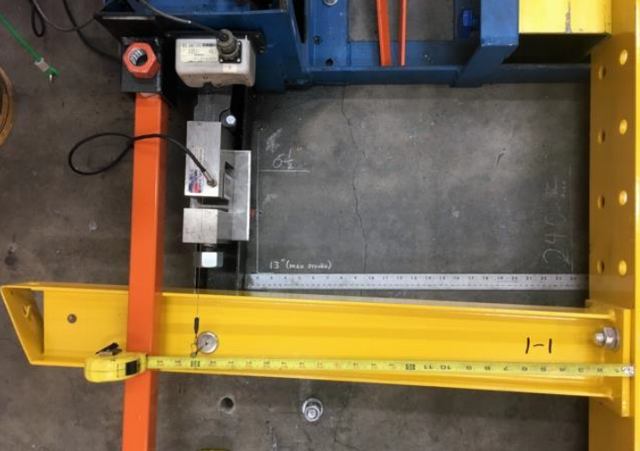
Reading
Further reading
Certification relevance
Arm connection strength and stiffness results are primary evidence a certification program (such as SMHE Certified) can evaluate for cantilever rack capacity ratings — the tested configurations define what a certified load table would stand on.
Testing provides evidence; it does not itself certify a product. Certification is a separate function.
Questions engineers ask
Frequently asked questions
What does an arm-to-column connection test evaluate?
It evaluates the strength, stiffness, and load-transfer behavior of the connection between a cantilever rack arm and its column. Because load on the arm creates a concentrated moment at this connection, the test measures how the connector, the arm end, and the column wall respond as load increases.
Is testing the arm connection the same as testing the arm?
No. An arm can have ample bending strength while its connection to the column governs the usable capacity. The connection test isolates the interface where load transfers into the column, which is often the controlling element in cantilever rack arm ratings.
How does connection test data support product capacity claims?
A capacity claim is stronger when it is supported by traceable evidence rather than assertion. Measured connection strength and stiffness give engineers, reviewers, and customers a documented basis for the published rating, and they define how the claim changes if the arm, connector, or column is modified.
Do we need to test every arm length and column combination?
No — a program is scoped so tested combinations bracket the product family, per the sampling approach the standard defines. Configurations that bound the moment demand and the column properties can cover intermediate ones, and the report states exactly which family the evidence supports.
Why does column thickness matter in an arm connection test?
Because the column wall is part of the connection: arm connectors bear on cold-formed material, and local deformation of the wall often contributes as much flexibility as the connector itself. A thinner or different-grade column can change the measured connection behavior even when the arm and connector are unchanged.
How do arm connection results feed a published load table?
Measured strength and stiffness anchor the table: they establish what the tested configurations carry, and they define the basis for values at configurations between the tested points. A table built on tested anchors is defensible in a way a purely calculated one is not.
Is this the assumption you need checked?
Tell us what you make, what changed, and what you need to know — we’ll confirm whether this test answers your question, or point you to the one that does.