

Lab testing · Test type
Beam-to-Column Cyclic Testing
Customer questionWhat stiffness and strength values can our engineers rely on for our beam-to-column connections in seismic design?
The short answer
What this test tells you
Your rack’s earthquake performance depends heavily on how the beam-to-column connection behaves when shaking pushes it back and forth. In this test we mount your actual beam, connector, and column in a load frame and cycle them through repeated reversals while measuring exactly how the connection responds. The result is a measured stiffness value and a performance curve your engineers can put directly into seismic calculations — and defend when a plan reviewer asks where the numbers came from. Testing turns the assumption behind your seismic design into evidence.
Why it matters
What decision does the result support?
Seismic models of storage racks are highly sensitive to the connection stiffness assumed in the analysis. If the assumed Kconn is too high, the model underestimates drift and second-order effects; if the connection degrades faster under cycling than assumed, the calculated seismic performance no longer describes the system that was built. A measured backbone curve converts that assumption into a defensible engineering input.
What the evidence supports
- engineering review
- plan check response
- product development
- seismic evaluation
- code/standard compliance support
- manufacturer claims
Typical project situations
- Developing seismic design inputs for a new pallet rack connector
- Qualifying a beam-to-column connection for projects in high-seismic regions
- Responding to plan check comments that ask how connection stiffness values were derived
- Comparing connector design revisions before a product change is released
- Replacing legacy or catalog stiffness assumptions with test-derived values
- Supporting rack seismic evaluations where connection behavior controls the analysis
What you receive
Test reports
The primary deliverable is the test report: what was tested, to which reference, with what instrumentation, what was measured, and what the result means for the assumption in question. What a test report contains is described on the Test reports page.
Important distinctions
What does this test not prove?
A cyclic test answers a different question than a static cantilever test. A static test measures strength and stiffness under a single loading direction; a cyclic test shows how the connection behaves when loading reverses repeatedly, including stiffness degradation and loss of moment capacity over cycles. Kconn is also a stiffness value, not a strength rating — a connection can be stiff and still have limited moment capacity, and the reverse is equally possible. Finally, a connection test produces design inputs for analysis; it does not by itself certify a complete rack system.
The question is not simply whether something held load. The question is whether the assumptions behind the design remain valid — and every test answers only the question it was designed to ask.
Whether this method is inside SMHE Lab’s accredited scope is stated in the Scope of Accreditation. Ask us to confirm before relying on an accredited result.
The assumption
What assumption does this test check?
The connection stiffness (Kconn) and cyclic moment-rotation behavior assumed in the rack’s seismic analysis match the measured behavior of the actual beam-to-column connection under repeated load reversal.
What it evaluates
What does this test evaluate?
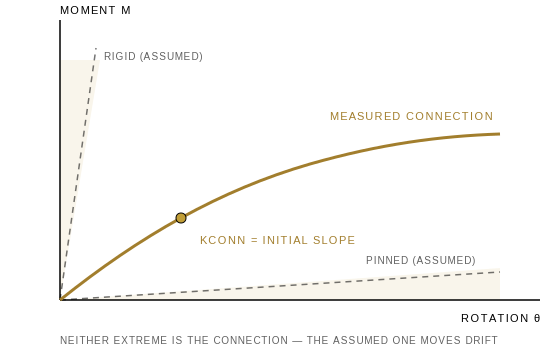
Cyclic beam-to-column connection testing applies repeated, reversing loads to a beam-to-column connection specimen and records its moment-rotation response over many cycles. The result is a backbone curve and a connection stiffness value, commonly called Kconn, along with a record of how strength and stiffness change as cycling progresses. ANSI MH16.1 identifies the cyclic beam-to-column connection test for evaluating connection performance under repeated cyclic loading, and the resulting values feed seismic analysis under ANSI MH16.1. A rack’s down-aisle behavior is governed largely by how its connections rotate under load reversal, so these measured quantities sit at the center of the seismic model.
Technical detail
How does the test work?
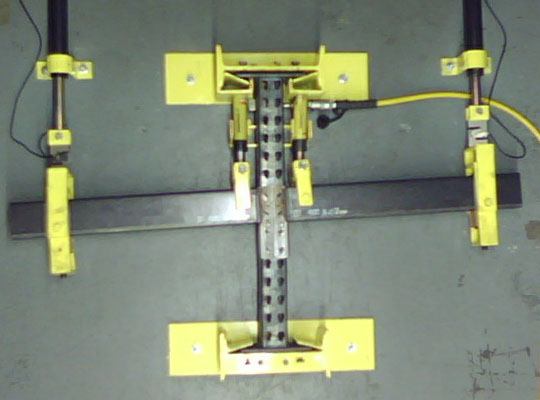
A cyclic beam-to-column test pairs a production beam segment, connector, and column section into a single connection specimen and mounts it in a reaction frame so the connection carries the applied moment. An actuator drives the beam end through reversing cycles following the protocol ANSI MH16.1 defines, while load cells record applied force and displacement transducers capture rotation across the connection region. Each cycle traces a hysteresis loop; together the loops describe how the connection develops, dissipates, and loses capacity as demand repeats and reverses. From that record the laboratory extracts the quantities seismic analysis needs: the backbone envelope traced through the loop peaks, an initial rotational stiffness — Kconn — derived from the early portion of the response, peak moment capacity, and the degradation of stiffness and strength across cycles. The report ties each value to the specimen that produced it: material identification, connector configuration, instrumentation layout, and the as-run loading history. The deliverable is a defensible seismic input rather than a pass/fail stamp. The measured Kconn and backbone curve feed frame models under ANSI MH16.1, where they govern calculated drift, period, and second-order effects. Because the values are specific to the tested beam, connector, and column combination, the report also defines the boundary of what the evidence supports.
Related assumptions
The assumptions on the line
Connection stiffness (Kconn)
The beam-to-column connection stiffness assumed in the frame model matches the finished connection’s measured behavior.
Rack connections are neither rigid nor pinned; an assumed extreme shifts drift, load path, and failure-mode predictions without any drawing changing.
Cyclic durability
Connection behavior holds under repeated and reversing loads, not only under a single push.
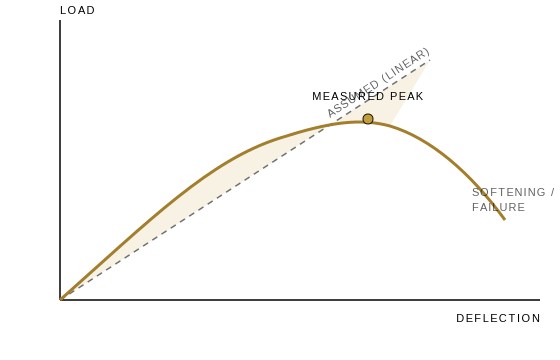
A connection can look fine monotonically and degrade cycle by cycle — seismic demand is a sequence, not a snapshot.
Connection strength
The connection can develop the moment and shear the analysis assigns to it.
Connector geometry, weld quality, and fabrication drift move strength while the part still looks identical to the one that passed.
Related standards
Related standards
ANSI MH16.1
We test to the reference the standard defines — not to convenience.
Evidence visuals
What the setup and the numbers look like
Reading
Further reading
Reading on this assumption
From the publications archive
- Rack Connection Stiffness: The Shift from F to Kconn
- Why §13.5.5 Stiffness Results Scatter — and Why That's Not a Testing Problem
- Clarifying Structural Loading Protocols: Why the Nuance Matters
- From Kconn to Backbone Curves: Why Connection Testing Is Quietly Entering Its Next Phase
Published articles live in the Knowledge Center; shorter notes in the publications archive.
Certification relevance
Cyclic connection results are core structural evidence a certification program (such as SMHE Certified) can evaluate for rack products intended for seismic applications — the measured Kconn, backbone curve, and degradation record substantiate the seismic design basis in the evidence packet.
Testing provides evidence; it does not itself certify a product. Certification is a separate function.
Questions engineers ask
Frequently asked questions
What is Kconn in storage rack design?
Kconn is the rotational stiffness of the beam-to-column connection used in rack structural analysis. It describes how much moment the connection develops per unit of rotation, and it strongly influences calculated drift, period, and force distribution in seismic models. Because assumed values can differ from actual connector behavior, Kconn is best established by testing the specific beam, column, and connector combination.
How is cyclic testing different from a static connection test?
A static test loads the connection in one direction and measures strength and stiffness up to a limit. A cyclic test reverses the load repeatedly, which reveals stiffness degradation, loss of moment capacity, and changes in behavior that a single-direction test cannot show. Seismic design inputs generally rely on cyclic results because earthquake loading reverses direction.
Does a cyclic connection test certify a rack system for seismic use?
No. The test produces measured connection properties — stiffness, backbone response, and degradation behavior — that engineers use as inputs to seismic analysis. Evaluation or approval of a complete rack system involves engineering review beyond a single connection test.
How many connection specimens does a cyclic test program require?
It depends on how many beam, column, and connector combinations the design family covers. Identical combinations are tested with replicates so results do not rest on a single data point, and families are bracketed so tested configurations bound the untested ones, per the sampling approach the standard defines. Scoping the program is a matter of mapping the product family before any specimen is built.
What does a cyclic connection test report contain?
The report documents the specimen — beam, connector, and column identification — the governing standard, the as-run loading protocol, hysteresis and backbone plots, and the derived stiffness and capacity values. It also records the photographic evidence chain from setup through post-test condition, so every reported number is traceable to the physical test that produced it.
Can Kconn from one beam-and-column combination be used for another?
Not directly. Kconn is a property of the specific beam, connector, and column combination, and changing beam depth, column thickness, or connector detail changes the measured value. That is why programs are scoped around the combinations the design values must cover rather than a single representative specimen.
Is this the assumption you need checked?
Tell us what you make, what changed, and what you need to know — we’ll confirm whether this test answers your question, or point you to the one that does.