

Lab testing · Test type
Beam-to-Column Static / Cantilever Testing
Customer questionHow much moment can our beam-to-column connection carry, and how stiff is it under load?
The short answer
What this test tells you
Every rack design assumes the beam-to-column connection has a certain strength and stiffness. This test checks those assumptions directly: we attach your beam to your column with your connector, load it in a controlled fixture, and measure how much moment the connection carries and how much it flexes on the way. The result is a documented set of design values your engineers — and anyone reviewing their work — can trace back to a physical test. If a connector, material, or tooling change is on the table, the same test shows what the change actually does.
Why it matters
What decision does the result support?
Rack design treats beam-to-column connections as semi-rigid, and the assumed connection values flow directly into beam capacity, deflection, and frame stability calculations. If the actual connector is weaker or more flexible than the assumed values, every calculation built on them inherits the error. A static cantilever test replaces those assumptions with measured evidence for the specific beam, column, and connector combination.
What the evidence supports
- engineering review
- plan check response
- product development
- manufacturer claims
- code/standard compliance support
Typical project situations
- Establishing design values for a new beam-to-column connector
- Verifying connection behavior after a change in material, tooling, or connector geometry
- Supporting published load capacity tables with test-derived connection values
- Responding to engineering review questions about how connection values were established
- Comparing connector performance across beam and column combinations
What you receive
Test reports
The primary deliverable is the test report: what was tested, to which reference, with what instrumentation, what was measured, and what the result means for the assumption in question. What a test report contains is described on the Test reports page.
Important distinctions
What does this test not prove?
A static cantilever test loads the connection in one direction and does not show how it behaves under repeated load reversal — that is the role of cyclic beam-to-column testing, which is generally the basis for seismic design inputs. The test also evaluates the connection region, not the full-span beam: pallet beam tests answer questions about beam bending and deflection over the clear span. Strength and stiffness are separate results as well; a connection can meet a strength target while being more flexible than the design assumed.
The question is not simply whether something held load. The question is whether the assumptions behind the design remain valid — and every test answers only the question it was designed to ask.
Whether this method is inside SMHE Lab’s accredited scope is stated in the Scope of Accreditation. Ask us to confirm before relying on an accredited result.
The assumption
What assumption does this test check?
The moment strength and rotational stiffness assumed for the beam-to-column connection in the rack design match the measured behavior of the connection under static loading.
What it evaluates
What does this test evaluate?
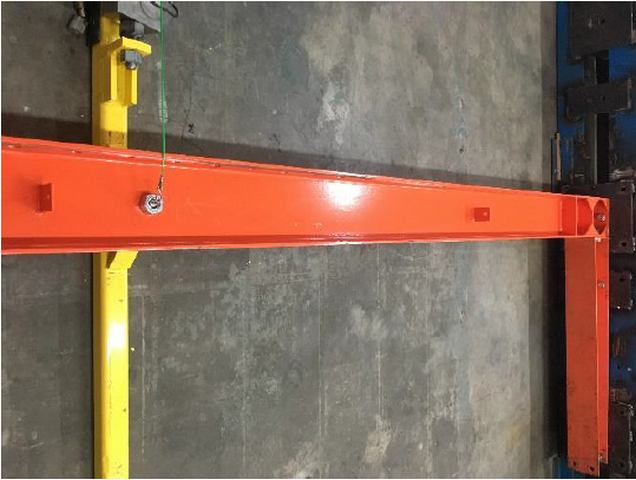
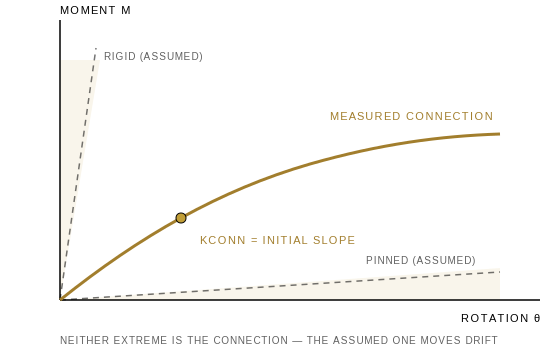
In a cantilever test, a beam segment is connected to a column section and loaded at the beam end, so the connection is forced to carry the resulting moment. The test measures beam strength and deflection response under cantilever loading, as described in ANSI MH16.1, and produces the connection’s static moment-rotation behavior, from which strength and stiffness values are derived. It is one of the standard methods by which connection design values for storage racks are established.
Technical detail
How does the test work?
The cantilever test isolates the beam-to-column connection by attaching a short beam segment to a column section with the production connector and loading the beam end at a defined distance from the column face, so the applied force resolves into a moment the connection must carry. The column is restrained in a reaction fixture; a load cell records applied force and displacement transducers record beam-end deflection, from which the moment-rotation response of the connection region is derived. Loading proceeds monotonically per the protocol ANSI MH16.1 defines, continuing until the connection’s limit behavior is reached. The extracted quantities are the connection’s static moment capacity and its rotational stiffness, taken from the measured moment-rotation curve. These become the connection design values behind beam capacity ratings, deflection checks, and semi-rigid frame analysis — the places where rack design has to represent a connection that is neither pinned nor fixed. Because the result belongs to a specific beam, connector, and column combination, the report records specimen identification, material references, instrumentation arrangement, and the measured curve alongside the derived values. That traceability is what lets the numbers survive an engineering review: the value, the specimen that produced it, and the method that connects them appear in one document.
Related assumptions
The assumptions on the line
Connection strength
The connection can develop the moment and shear the analysis assigns to it.
Connector geometry, weld quality, and fabrication drift move strength while the part still looks identical to the one that passed.
Connection stiffness (Kconn)
The beam-to-column connection stiffness assumed in the frame model matches the finished connection’s measured behavior.
Rack connections are neither rigid nor pinned; an assumed extreme shifts drift, load path, and failure-mode predictions without any drawing changing.
Related standards
Related standards
ANSI MH16.1
We test to the reference the standard defines — not to convenience.
Evidence visuals
What the setup and the numbers look like
Reading
Further reading
Certification relevance
Static connection strength and stiffness values are direct evidence behind published rack capacity claims, so cantilever test reports belong in a certification evidence packet for beam-and-connector product families.
Testing provides evidence; it does not itself certify a product. Certification is a separate function.
Questions engineers ask
Frequently asked questions
What does a cantilever test measure?
A cantilever test loads a beam segment attached to a column section so the connection carries the resulting moment. It measures the load and deflection response and produces the static moment-rotation behavior of the connection, from which strength and stiffness values are derived for design.
Is a static cantilever test enough for seismic design?
Not by itself. A static test shows one-direction behavior, while seismic loading reverses direction repeatedly, so seismic connection inputs generally come from cyclic beam-to-column testing. Static results remain valuable for gravity design values and for comparing connector revisions.
Does a cantilever test tell me the beam’s span capacity?
No. The cantilever test concentrates demand at the connection, so it characterizes connection behavior rather than the beam’s full-span bending and deflection performance. Pallet beam tests evaluate the beam itself, including simply supported conditions or installation within upright frame assemblies.
How is a cantilever test program scoped?
Scope follows the product family: each distinct beam, connector, and column combination behaves differently, so the program identifies which combinations must be tested directly and which can be bracketed by tested ones, with replicates per the sampling approach the standard defines. Mapping the family first is what keeps the program efficient rather than exhaustive.
When should a manufacturer re-test an existing connection?
Re-testing is warranted when the material grade, connector geometry, tooling, or column section changes — the published values belong to the configuration that was tested, not to the part number. A connection can look identical after a supplier or process change and still measure differently.
Is a stiffer connection always better?
Not necessarily. Stiffness and strength are separate results, and design needs the actual values rather than the most flattering ones — a stiffer connection changes how load distributes through the frame, which can raise demands elsewhere. The goal of testing is an accurate input, not an impressive one.
Is this the assumption you need checked?
Tell us what you make, what changed, and what you need to know — we’ll confirm whether this test answers your question, or point you to the one that does.