
Lab testing · Test type
Cantilever Arm Testing
Customer questionCan my cantilever arms carry their rated load without excessive deflection or connection distress?
The short answer
What this test tells you
Cantilever arm testing answers two questions at once: how much load an arm can safely carry, and how far it tips down while carrying it. We mount a production arm on its column the way it is actually connected, load it, and measure deflection and strength together. The test also shows what gives way first — the arm, the connector, or the column wall — which determines what a safe rating looks like. If you make or specify cantilever rack, this is the measured evidence behind the arm ratings your customers rely on.
Why it matters
What decision does the result support?
In cantilever storage, the arms carry the entire stored load, and arm rotation directly affects whether long loads stay where they were placed. If the strength or stiffness assumption behind an arm rating is wrong, the rating overstates performance for every arm in service. Measured arm behavior gives the rating a traceable basis instead of an assertion.
What the evidence supports
- product development
- manufacturer claims
- engineering review
- plan check response
- code/standard compliance support
Typical project situations
- Rating a new cantilever arm design
- Qualifying an arm-to-column connection detail
- Verifying deflection behavior at rated load
- Comparing arm lengths, bracket designs, or design revisions
- Supporting engineering review of an existing cantilever product
- Evaluating a change in material, weld detail, or connector geometry
What you receive
Test reports
The primary deliverable is the test report: what was tested, to which reference, with what instrumentation, what was measured, and what the result means for the assumption in question. What a test report contains is described on the Test reports page.
Important distinctions
What does this test not prove?
A cantilever arm test evaluates the arm and its connection as a component; it does not evaluate the stability of the full cantilever column, base fixity, or the rack as a system under lateral or seismic loading. It also differs from an arm-to-column connection test, which focuses on characterizing the connection’s strength, stiffness, and load-transfer behavior rather than the arm’s overall strength and deflection. A measured arm capacity is the evidence behind a published rating, not a substitute for checking that the rating applies to the configuration actually in service.
The question is not simply whether something held load. The question is whether the assumptions behind the design remain valid — and every test answers only the question it was designed to ask.
Whether this method is inside SMHE Lab’s accredited scope is stated in the Scope of Accreditation. Ask us to confirm before relying on an accredited result.
The assumption
What assumption does this test check?
The assumption that a cantilever arm and its connection to the column deliver the strength and stiffness used to establish the arm’s rated capacity.
What it evaluates
What does this test evaluate?
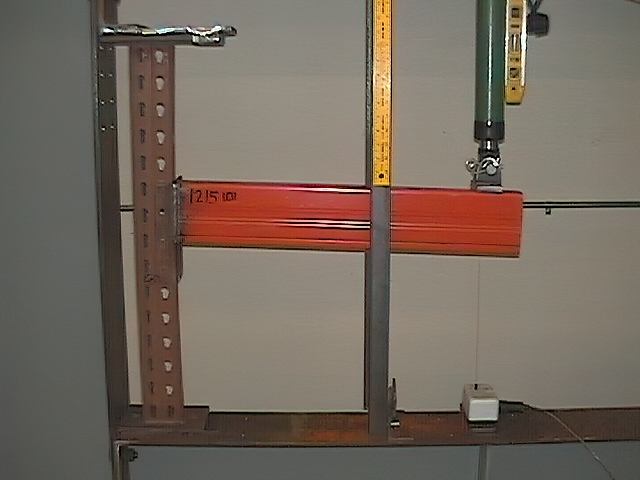
Cantilever arm testing measures strength and deflection response under cantilever loading, where load applied along the arm produces bending in the arm and concentrated demand at the arm-to-column connection. The test records tip deflection, arm rotation, and the load at which capacity is reached. It also shows where capacity is actually governed — in the arm section, the connector hardware, or the column wall at the connection — which is information calculation alone rarely settles.
Technical detail
How does the test work?
Cantilever arm testing mounts an arm on a representative column segment in its production connection and applies load along the arm per the protocol the governing standard defines. Because the load path is a cantilever, bending demand grows toward the connection, concentrating force in the arm-to-column interface — the connector hardware and the column wall it bears against. The setup therefore includes the connection as built, not an idealized fixity. Instrumentation records applied load through a calibrated load cell and displacement at the arm tip, with additional transducers capturing arm rotation and connection movement where the governing behavior needs to be separated into its parts. Loading proceeds monotonically while load, tip deflection, and rotation are recorded continuously. The extracted quantities are the arm’s stiffness and deflection at candidate rated loads, the ultimate load, and — importantly — the observed governing mode: yielding of the arm section, deformation of the connector, or local distress in the column wall. Which of those governs is difficult to settle by calculation and directly shapes how a rating can be extended across arm lengths and load positions. The result is reduced against the requirements of ANSI MH16.3 and reported with configuration details, the measured response, and the governing behavior. That record is what an arm’s published rating should trace to, and what load table development for a cantilever line builds on.
Related assumptions
The assumptions on the line
Member capacity vs. published values
Beams, arms, shelves, and decks carry what their published load tables state.
Tables outlive the tooling, suppliers, and details that produced them; the table stays printed while the product underneath it changes.
Connection strength
The connection can develop the moment and shear the analysis assigns to it.
Connector geometry, weld quality, and fabrication drift move strength while the part still looks identical to the one that passed.
Related standards
Related standards
ANSI MH16.3
We test to the reference the standard defines — not to convenience.
Evidence visuals
What the setup and the numbers look like
Reading
Further reading
Certification relevance
Measured arm strength, deflection, and governing behavior are the component-level evidence a cantilever product’s arm ratings would trace to in a certification evidence packet.
Testing provides evidence; it does not itself certify a product. Certification is a separate function.
Questions engineers ask
Frequently asked questions
What does a cantilever arm test measure?
A cantilever arm test measures the strength and deflection response of an arm under cantilever loading, including the behavior of its connection to the column. It records how much the arm tip deflects as load increases and the load at which capacity is reached. The result identifies whether the arm, the connector, or the column wall governs.
Why does arm deflection matter if the arm does not fail?
Under cantilever loading, arm rotation changes the slope of the storage surface, which affects whether long or round loads stay in place. An arm can retain strength while deflecting more than the design assumed, and that stiffness assumption is part of what the test checks. Strength and deflection are separate questions, and the test answers both.
Does an arm test evaluate the whole cantilever rack?
No. It characterizes the arm and its connection as a component, not column stability, base behavior, or the rack’s response to lateral and seismic loading. Those are system-level questions addressed through other tests and engineering analysis that use the arm test result as an input.
Does a stronger arm section always mean a higher rating?
Not necessarily. Cantilever loading concentrates demand at the arm-to-column connection, and the connector or the column wall can govern before the arm section does. Upgrading the arm without evaluating the connection can leave the rating exactly where it was — the test identifies which part actually sets the limit.
How many arm configurations need testing to support a load table?
Arm ratings vary with arm length and load position, so a table generally rests on tests that bracket the range the product line offers, per the approach the governing standard defines. Interpolating between measured configurations is an engineering step that needs measured anchor points at the extremes. Scoping starts from the table you want to publish.
What does a cantilever arm test report include?
It documents the arm and connection configuration, the column segment used, the load application point, the recorded load–deflection response, the ultimate load, and the observed governing behavior. Photographs record the connection before, during, and after loading. The report is written so a rating can trace back to a specific measured specimen.
Is this the assumption you need checked?
Tell us what you make, what changed, and what you need to know — we’ll confirm whether this test answers your question, or point you to the one that does.