

Lab testing · Test type
Cyclic Upright Frame Bracing Connection Testing
Customer questionWill our frame bracing connections keep their strength after repeated seismic-type loading?
The short answer
What this test tells you
Earthquakes do not push on a structure once — they shake it back and forth many times. This test does the same thing to the joint where a brace meets a column: loading it, reversing it, and repeating, while we measure whether the connection keeps its strength or gradually loosens. Some joints pass a single pull and still degrade cycle by cycle, which is exactly what a seismic design cannot afford. The result tells you whether this connection holds up through a realistic earthquake load history, and it gives engineers and plan checkers the evidence they ask for on seismic projects.
Why it matters
What decision does the result support?
Seismic analysis assumes the frame’s bracing connections deliver force not once but through many reversals, and a connection that degrades early leaves the frame with less stiffness and strength than the model assumes. Racks in seismic jurisdictions depend on that assumption holding; cyclic testing is how it becomes evidence rather than expectation.
What the evidence supports
- engineering review
- plan check response
- product development
- code/standard compliance support
- seismic evaluation
- manufacturer claims
Typical project situations
- Seismic qualification of an upright frame bracing connection detail
- Evaluating bolted brace connections where slip and hole elongation under reversals are a concern
- Supporting rack designs intended for high-seismic installations
- Checking whether a detail change affects cyclic performance, not just static capacity
- Responding to engineering or plan check requests for cyclic test data
What you receive
Test reports
The primary deliverable is the test report: what was tested, to which reference, with what instrumentation, what was measured, and what the result means for the assumption in question. What a test report contains is described on the Test reports page.
Important distinctions
What does this test not prove?
A static bracing connection test answers whether the joint can carry load once; this test answers whether it keeps carrying load through reversals. It is still a connection test: it does not measure the global shear stiffness of the assembled frame, and it does not evaluate down-aisle behavior, which is the subject of portal stability testing. Passing a static test is not evidence of cyclic performance — degradation mechanisms such as slip growth and low-cycle fatigue only appear under repeated loading.
The question is not simply whether something held load. The question is whether the assumptions behind the design remain valid — and every test answers only the question it was designed to ask.
Whether this method is inside SMHE Lab’s accredited scope is stated in the Scope of Accreditation. Ask us to confirm before relying on an accredited result.
The assumption
What assumption does this test check?
The upright frame bracing connection retains the strength and stiffness assumed in the seismic design after repeated load reversals.
What it evaluates
What does this test evaluate?
This test subjects an upright frame bracing connection to repeated cycles of reversed loading and tracks how its strength and stiffness change as the cycles accumulate. It captures behavior that a single static pull cannot: bolt-hole elongation, slip growth, weld cracking, and gradual softening of the joint. The result is a record of how the connection performs across the load history a seismic event would impose, per ANSI MH16.1.
Technical detail
How does the test work?
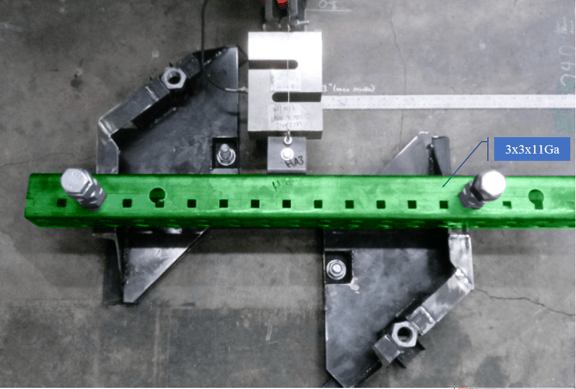
The specimen and fixture mirror the static bracing connection test: a production brace-to-column joint mounted at its in-frame angle, with a load cell measuring force and displacement transducers tracking movement across the connection. The difference is the loading. An actuator drives the joint through repeated cycles of reversed load per the protocol ANSI MH16.1 defines, so the connection experiences the kind of load history a seismic event imposes rather than a single pull. The force-deformation response is recorded continuously, producing hysteresis loops that show how the joint dissipates energy and how its behavior changes as cycles accumulate. From that record come the quantities seismic design needs: strength and stiffness retention across the load history, slip growth at bolted interfaces, hole elongation, and the onset of weld cracking or other degradation. The backbone envelope traced through the cyclic response provides a defensible characterization of the connection for seismic analysis, and the degradation record shows whether the values assumed in design survive repetition. The report pairs the measured response with photographs of the specimen at behavior landmarks, so the difference between the first cycle and the last is documented rather than inferred. The result is evidence that the bracing connection performs through reversals — the assumption every seismic frame analysis makes and no static test can confirm.
Related assumptions
The assumptions on the line
Cyclic durability
Connection behavior holds under repeated and reversing loads, not only under a single push.
A connection can look fine monotonically and degrade cycle by cycle — seismic demand is a sequence, not a snapshot.
Bracing load path
Frame bracing connections deliver the load path the frame analysis assumed.
The brace member may be fine while its end connection governs — the path fails at the joint the model drew as a node.
Related standards
Related standards
ANSI MH16.1
We test to the reference the standard defines — not to convenience.
Evidence visuals
What the setup and the numbers look like
Reading
Further reading
Certification relevance
Cyclic connection performance is core evidence a certification program (such as SMHE Certified) can evaluate for products intended for seismic applications — the degradation record shows that the design values survive a realistic load history, not just a single pull.
Testing provides evidence; it does not itself certify a product. Certification is a separate function.
Questions engineers ask
Frequently asked questions
What does a cyclic upright frame bracing connection test measure?
It measures how the strength and stiffness of a brace-to-column connection change under repeated load reversals, following ANSI MH16.1. The output includes hysteretic behavior and any degradation such as slip growth, hole elongation, or weld cracking.
If a connection passed a static test, does it still need cyclic testing?
For seismic applications, often yes. Static capacity says nothing about degradation under reversals — a joint can carry its full static load and still lose stiffness or strength after repeated cycling. Cyclic testing validates the assumption that the connection performs through the load history an earthquake imposes.
Is this test the same as a seismic test of the whole rack?
No. It qualifies one connection detail, not the complete rack system. Frame-level and system-level behavior involve additional effects — brace geometry, base fixity, and interaction between components — that connection tests do not capture.
What does a cyclic bracing connection test report include?
It includes the loading protocol reference, the full hysteretic response, the backbone envelope traced through the cycles, and a degradation summary covering slip growth, hole elongation, or cracking. Photographs at behavior landmarks document the specimen’s condition as cycling progresses, so the record shows what changed and when — not just the final state.
Can static and cyclic bracing connection tests be run as one program?
Yes, and it is often the efficient way to scope the work. Both tests use the same specimen family and fixturing, and the static results establish the baseline behavior against which cyclic degradation is judged. Programs that need both answers usually plan them together rather than sequentially.
Which connection details are most sensitive to cyclic degradation?
Bolted details with slip-sensitive interfaces tend to accumulate hole elongation and slip growth under reversals, and welds in thin cold-formed sections can develop cracking that a single static pull never initiates. Sensitivity is detail-specific, which is why cyclic evidence belongs to the tested detail rather than to connection types in general.
Is this the assumption you need checked?
Tell us what you make, what changed, and what you need to know — we’ll confirm whether this test answers your question, or point you to the one that does.