

Lab testing · Test type
Modified Impact / Pendulum / Drop Tower Testing
Customer questionCan our product absorb the impact it is claimed to handle?
The short answer
What this test tells you
If your product is sold on its ability to take a hit — a mesh panel that contains falling items, a guard that protects people or equipment — this test measures whether it actually can. We mount your product the way it would be installed, strike it with a known amount of energy from a pendulum or drop weight, and document exactly how it responds: how it deforms, whether it stays attached, and whether it keeps doing its job. The result is evidence you can put behind the claim, instead of an assertion a buyer or official has to take on faith.
Why it matters
What decision does the result support?
Containment and guarding products are often selected on the basis of an impact performance claim, and static capacity says little about how a panel behaves when energy arrives suddenly. If the impact assumption is wrong, a product can deform, detach, or release what it was meant to contain. Documented impact response lets a manufacturer support the claim with evidence rather than assertion.
What the evidence supports
- product development
- manufacturer claims
- product certification
- engineering review
- code/standard compliance support
Typical project situations
- Developing or revising mesh containment panels and guarding products
- Supporting an impact performance claim with documented test evidence
- Comparing design revisions for energy absorption and attachment behavior
- Evaluating fastener and connection behavior under sudden loading
- Screening material toughness when fabrication or supplier changes raise questions
- Building the evidence base for a certification submittal
What you receive
Test reports
The primary deliverable is the test report: what was tested, to which reference, with what instrumentation, what was measured, and what the result means for the assumption in question. What a test report contains is described on the Test reports page.
Important distinctions
What does this test not prove?
Impact energy response and static capacity are different questions. A panel that carries a static load comfortably may behave very differently when the same energy arrives in a fraction of a second, and a good impact result does not establish a static load rating. Component-level impact testing also differs from material impact testing: one evaluates a product configuration, the other characterizes the material itself. Results apply to the tested configuration and impact energy, not to every possible collision.
The question is not simply whether something held load. The question is whether the assumptions behind the design remain valid — and every test answers only the question it was designed to ask.
Whether this method is inside SMHE Lab’s accredited scope is stated in the Scope of Accreditation. Ask us to confirm before relying on an accredited result.
The assumption
What assumption does this test check?
The component or panel can absorb the impact energy assumed in its design or product claim while continuing to perform its intended function.
What it evaluates
What does this test evaluate?
Impact testing delivers a defined amount of energy to a specimen using a pendulum or drop tower and observes how the component responds — deformation, energy absorption, attachment behavior, and whether the part continues to do its job. For components and panels, such as mesh containment products, the setup is adapted so the delivered impact represents the demand behind the product claim. The result is a documented energy-response relationship rather than a static load number.
Technical detail
How does the test work?
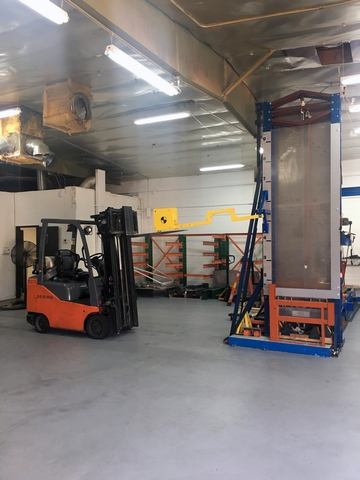
Impact testing replaces the gradual loading of a static test with a defined delivery of energy. The specimen — a mesh containment panel, guard, or other component — is mounted in a fixture that reproduces the restraint and attachment details of its intended installation, because impact response depends on how the part is held as much as on the part itself. A pendulum mass or drop tower delivers the impact; the energy is set by mass and release height or swing geometry, so the delivered demand is known and repeatable. Instrumentation and documentation capture what the sudden energy does: measured permanent deformation, attachment and fastener behavior, whether the specimen released or retained what it was meant to contain, and photographic records of the response sequence. A program may test at a single energy representing the product claim or step through increasing energies to map where behavior changes. The extracted result is an energy-response relationship for the tested configuration: the delivered energy, the observed response, and the condition in which the specimen continued to perform its function. That documented relationship becomes the defensible basis for an impact performance claim, a comparison between design revisions, or the impact-resistance portion of a certification evidence package.
Related assumptions
The assumptions on the line
Impact energy response
The component absorbs or resists the impact energy its application assumes.
Impact response depends on restraint and connection detail, not just the part — the same panel behaves differently in a different frame.
Finished-part material properties
The finished component retains the strength and ductility the design took from the material certificate.
Roll-forming, punching, welding, and cold work change the part — strength can stay high while ductility drops. The certificate describes the coil, not the column.
Evidence visuals
What the setup and the numbers look like
Reading
Further reading
Certification relevance
A documented energy-response result for a defined product configuration can serve as the performance evidence behind an impact claim in a certification evidence packet, provided the specimens are traceable to production and the delivered energy maps to the published claim.
Testing provides evidence; it does not itself certify a product. Certification is a separate function.
Questions engineers ask
Frequently asked questions
What is the difference between impact testing and static load testing?
Static testing applies load gradually and measures capacity and deflection. Impact testing delivers a defined amount of energy suddenly, using a pendulum or drop mass, and observes how the component absorbs it. A product can perform well in one and poorly in the other, so the right test depends on which demand the design assumption describes.
What kinds of products are tested with pendulum or drop tower methods?
Typical specimens include mesh containment panels, guarding components, rack accessories, and other parts whose function involves absorbing or containing a sudden impact. The setup is adapted so the delivered energy and impact location represent the demand behind the product claim.
Does passing an impact test certify the product?
No. An impact test produces documented evidence of how a specific configuration responded to a specific energy. Certification is a separate evaluation of that evidence against defined criteria, and a claim is stronger when it is supported by traceable evidence rather than assertion.
How is the impact energy for a test selected?
The energy comes from the demand behind the product claim — what the product is expected to stop, arriving at what speed or from what height. Because the delivered energy is set by the mass and geometry of the pendulum or drop, it is known and repeatable, and a program can test at the claimed energy or step upward to find where behavior changes.
Can one impact test cover a whole family of panel sizes?
Sometimes, but only with a deliberate bracketing strategy. Impact response depends on span, attachment details, and restraint, so a family claim is typically supported by testing the configurations that bound the behavior rather than a single midpoint specimen. Scoping starts by mapping the product family before choosing what to test.
What does an impact test report contain?
The report documents the specimen and its mounting, the rig configuration, the delivered impact energy, and the observed response — deformation, attachment behavior, and whether the specimen retained its function. Photographic documentation of the response sequence is included so a reviewer can verify what happened, and in what order.
Is this the assumption you need checked?
Tell us what you make, what changed, and what you need to know — we’ll confirm whether this test answers your question, or point you to the one that does.