

Lab testing · Test type
Pallet Beam Testing
Customer questionWill my pallet beams carry their rated load without excessive deflection?
The short answer
What this test tells you
Pallet beam testing shows whether your beams actually do what your load table says. We load real production beams — on simple supports or installed in an upright frame, the way they work in service — and measure both how much they carry and how much they bend along the way. The result tells you the load your beams can be rated for and whether they stay acceptably stiff at that load. For a manufacturer, that is the difference between a published capacity you can defend and one you have to hope about. Testing turns the numbers in your catalog into evidence.
Why it matters
What decision does the result support?
Published beam capacities rest on assumptions about section properties, connector restraint, and deflection limits. If those assumptions are off, beams can deflect more than expected at rated load or reach capacity below the tabulated value, and the load table stops being a reliable engineering input. Measured beam behavior gives manufacturers and reviewing engineers evidence they can defend rather than a number they must take on faith.
What the evidence supports
- product development
- manufacturer claims
- engineering review
- plan check response
- code/standard compliance support
Typical project situations
- Developing or updating load tables for a beam product line
- Qualifying a new beam section or end connector design
- Verifying beam capacity after a material or tooling change
- Comparing simply supported and in-frame beam behavior
- Supporting engineering review of an existing beam product
- Evaluating a beam for a configuration outside its original table
What you receive
Test reports
The primary deliverable is the test report: what was tested, to which reference, with what instrumentation, what was measured, and what the result means for the assumption in question. What a test report contains is described on the Test reports page.
Important distinctions
What does this test not prove?
A pallet beam test measures the beam and its end connections as a component; it is not a full rack system test and does not evaluate frame stability, anchorage, or seismic system behavior. It also differs from a beam-to-column connection test, which characterizes the connection itself rather than the beam’s strength and deflection. And a measured beam capacity is not interchangeable with a published table value — the measured result is the evidence a table value should trace back to, which matters when a beam’s actual configuration differs from the tested one.
The question is not simply whether something held load. The question is whether the assumptions behind the design remain valid — and every test answers only the question it was designed to ask.
Whether this method is inside SMHE Lab’s accredited scope is stated in the Scope of Accreditation. Ask us to confirm before relying on an accredited result.
The assumption
What assumption does this test check?
The assumption that a pallet beam’s strength and stiffness — including the restraint contributed by its end connections — match the values behind its published capacity.
What it evaluates
What does this test evaluate?
Pallet beam testing evaluates the structural performance of pallet beams under load, either simply supported or installed within upright frame assemblies. It measures strength and deflection behavior, including how the beam-to-column end connectors influence the beam’s effective stiffness and capacity. Testing within a frame assembly captures the partial end restraint that a simply supported test deliberately excludes, so the two configurations answer related but different questions about the same beam.
Technical detail
How does the test work?
Pallet beam testing places a beam pair — or a single beam, depending on the question — under controlled vertical loading in one of two configurations. A simply supported setup isolates the member on idealized supports; an in-frame setup installs the beams in upright frames with their production end connectors, so the partial rotational restraint of the connections participates in the response. Load is applied through a calibrated system arranged to represent the intended load distribution, and displacement transducers record deflection, typically at midspan, as loading proceeds per the protocol the governing standard defines. The recorded load–deflection response yields the quantities design depends on: stiffness across the service range, deflection at rated load, and the load at which strength or serviceability limits are reached. Comparing simply supported and in-frame results also quantifies how much the end connections contribute — restraint the design either counts on or ignores, and either way should be measured rather than assumed. Results are reduced against the acceptance basis of ANSI MH16.1 and reported with specimen dimensions, material references, support conditions, and the full measured curve, not just a peak value. The deliverable is a capacity determination a load table entry can trace to: a reviewing engineer can follow the published number back to a measured specimen, a documented configuration, and a recorded response.
Related assumptions
The assumptions on the line
Member capacity vs. published values
Beams, arms, shelves, and decks carry what their published load tables state.
Tables outlive the tooling, suppliers, and details that produced them; the table stays printed while the product underneath it changes.
Connection stiffness (Kconn)
The beam-to-column connection stiffness assumed in the frame model matches the finished connection’s measured behavior.
Rack connections are neither rigid nor pinned; an assumed extreme shifts drift, load path, and failure-mode predictions without any drawing changing.
Related standards
Related standards
ANSI MH16.1
We test to the reference the standard defines — not to convenience.
Evidence visuals
What the setup and the numbers look like
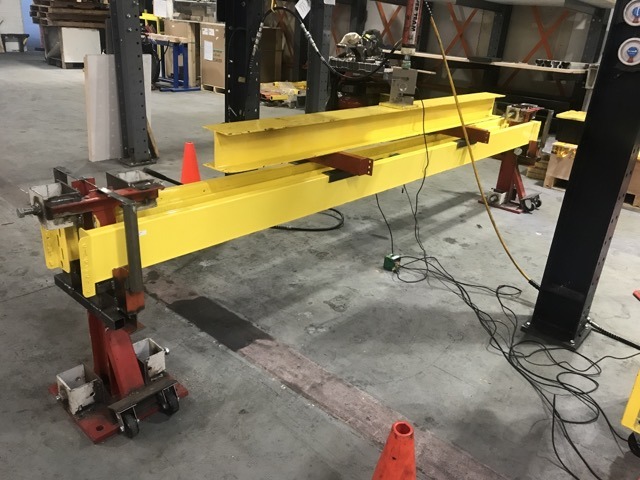
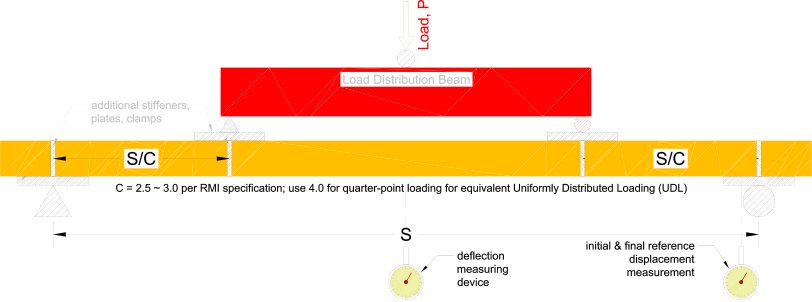
Reading
Further reading
Certification relevance
Measured beam strength and deflection behavior is primary evidence a certification program (such as SMHE Certified) can evaluate for beam products, tying a published load table in a certification evidence packet to specimens that were physically tested.
Testing provides evidence; it does not itself certify a product. Certification is a separate function.
Questions engineers ask
Frequently asked questions
What does a pallet beam test measure?
A pallet beam test measures the strength and deflection behavior of a pallet beam under controlled loading, either simply supported or installed in an upright frame assembly. It shows the load at which the beam reaches capacity and how much it deflects along the way. The result turns the assumptions behind a published beam capacity into measured evidence.
What is the difference between a simply supported test and an in-frame beam test?
A simply supported test isolates the beam itself, with idealized end conditions. An in-frame test includes the actual end connectors and columns, so it captures the partial end restraint the connections provide, which affects both stiffness and capacity. The right configuration depends on which assumption in the design needs to be validated.
Does a pallet beam test prove the whole rack system is adequate?
No. It characterizes the beam and its end connections, not frame stability, anchorage, slab support, or seismic system behavior. System-level adequacy depends on engineering analysis that uses beam test results as one input among several.
Is beam capacity usually governed by strength or by deflection?
Either can govern, and the test identifies which. Many beams can carry more load than their deflection behavior allows them to be rated for, because serviceability limits cap the usable capacity before strength does. That is why the full load–deflection curve, not just the peak load, is the deliverable.
How many beam specimens does a load table program need?
It depends on the range of sections, spans, and connector types the table covers and on the bracketing approach the governing standard defines. Testing representative configurations at the boundaries of a product family often characterizes the members between them. Scoping starts from the table you intend to publish, not from a fixed specimen count.
When should a manufacturer retest an established beam line?
Whenever something the original tests depended on changes: steel supplier or grade, tooling, section geometry, connector design, or weld details. The published table describes the beams that were tested, and production changes can quietly move behavior while the catalog stays the same. Retesting re-anchors the table to the product actually shipping.
Is this the assumption you need checked?
Tell us what you make, what changed, and what you need to know — we’ll confirm whether this test answers your question, or point you to the one that does.