
Lab testing · Test type
Partial-Assembly Static Shelf Testing
Customer questionWill my shelves carry their rated load the way they are actually supported?
The short answer
What this test tells you
A shelf rating is a promise about how the shelf performs on its real supports — not on ideal ones. This test loads your shelf exactly as it is built: with its production clips, connectors, and posts. We measure how much it deflects under load, when it reaches its limit, and what gives way first. The result is a measured basis for the load rating in your catalog, the kind of evidence a reviewing engineer or certification file can rely on. Testing turns a printed rating into a claim you can stand behind.
Why it matters
What decision does the result support?
Shelf load ratings rest on assumptions about how load distributes to the supports and what restraint the connections provide. If those assumptions are wrong, a shelf can deflect excessively or its connections can deform below the rated load, and the published rating loses its basis. For a manufacturer, a rating that traces to measured assembly behavior is a claim supported by evidence rather than assertion.
What the evidence supports
- product development
- manufacturer claims
- product certification
- engineering review
- code/standard compliance support
Typical project situations
- Establishing or verifying shelf load ratings
- Qualifying a new shelf design or a gauge change
- Verifying capacity after a supplier or material change
- Supporting shelving product literature with test evidence
- Responding to engineering review of shelving capacity
- Comparing shelf design revisions on a measured basis
What you receive
Test reports
The primary deliverable is the test report: what was tested, to which reference, with what instrumentation, what was measured, and what the result means for the assumption in question. What a test report contains is described on the Test reports page.
Important distinctions
What does this test not prove?
A partial-assembly shelf test evaluates the shelf with its representative supports and connections; that is different from testing a shelf panel alone, which excludes the connection behavior that often controls. It is also not a shelving-unit system test — it does not evaluate post buckling, unit stability, or seismic behavior. And it differs from a shelf-to-post shear connection test, which isolates the connection itself rather than the shelf’s performance in context.
The question is not simply whether something held load. The question is whether the assumptions behind the design remain valid — and every test answers only the question it was designed to ask.
Whether this method is inside SMHE Lab’s accredited scope is stated in the Scope of Accreditation. Ask us to confirm before relying on an accredited result.
The assumption
What assumption does this test check?
The assumption that a shelf’s rated capacity holds when the shelf is carried by its actual connections and supporting members rather than idealized supports.
What it evaluates
What does this test evaluate?
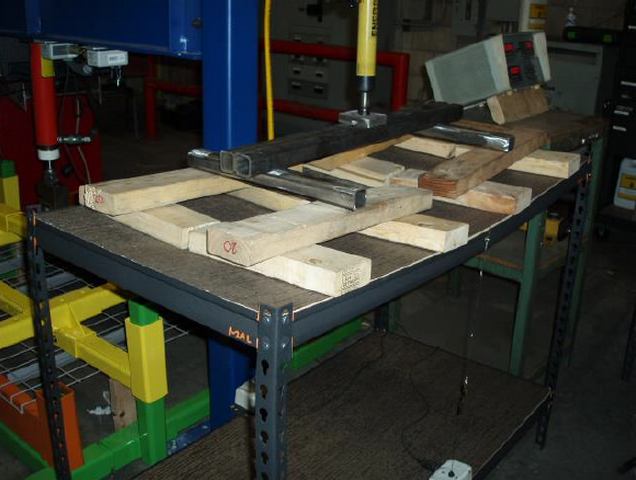
Partial-assembly static shelf testing assesses shelf performance in a representative partial assembly under static loading — the shelf installed with its production clips, connectors, and posts. The test measures how the shelf deck bends, how the supports engage, and how load is actually shared among the connections, none of which idealized calculations fully capture. The measured result reflects the shelf as it is supported in service, not as an isolated panel.
Technical detail
How does the test work?
Partial-assembly static shelf testing installs the shelf on its production supports — clips, connectors, and post sections engaged as they would be in service — and applies static load per the protocol the governing standard defines. Load is distributed across the shelf surface in a documented pattern representing the rating basis, and instrumentation records applied load and deflection at the locations that characterize the response, typically including the deck center and support points. Where connection behavior is part of the question, additional measurements track how the supports engage and deform. Loading proceeds statically while the response is recorded through the service range and to the limit the scope targets. The extracted quantities are shelf deflection at candidate rated loads, the load at which serviceability or strength limits are reached, and the observed governing behavior — deck bending, support engagement, or connection deformation. Because load rarely shares evenly among shelf connections, measuring the assembly rather than the panel captures the distribution effects a rating actually depends on. Results are reduced against the applicable requirements of the MH28 shelving standards, and reported with the shelf configuration, support condition, load pattern, and the full measured response. The deliverable is a rating basis that traces to a measured assembly: the number printed in a catalog or certification packet connects to a physical shelf, on its real supports, that was loaded and measured.
Related assumptions
The assumptions on the line
Member capacity vs. published values
Beams, arms, shelves, and decks carry what their published load tables state.
Tables outlive the tooling, suppliers, and details that produced them; the table stays printed while the product underneath it changes.
Connection strength
The connection can develop the moment and shear the analysis assigns to it.
Connector geometry, weld quality, and fabrication drift move strength while the part still looks identical to the one that passed.
Related standards
Related standards
ANSI MH28.1ANSI MH28.2
We test to the reference the standard defines — not to convenience.
Evidence visuals
What the setup and the numbers look like
Reading
Further reading
Certification relevance
Shelving is a certifiable product family, and partial-assembly shelf results provide the measured capacity evidence a certification evidence packet ties catalog ratings to.
Testing provides evidence; it does not itself certify a product. Certification is a separate function.
Questions engineers ask
Frequently asked questions
What is a partial-assembly static shelf test?
It is a static load test of a shelf installed in a representative partial assembly, with its actual clips, connectors, and posts. The test measures shelf deflection and capacity as the shelf is actually supported, including how load is shared among the connections. This grounds a shelf load rating in measured behavior rather than idealized assumptions.
How is this different from testing the shelf panel by itself?
A shelf panel tested alone excludes the connections and supports, which are often what actually govern shelving behavior. The partial-assembly test includes them, so it captures support engagement, connection deformation, and uneven load sharing. Each configuration validates a different assumption; the partial-assembly test validates the one most ratings depend on.
Does this test evaluate the stability of the whole shelving unit?
No. It characterizes the shelf and its immediate supports under static load, not post buckling, unit stability, or seismic behavior. Unit-level adequacy is a system question addressed through additional testing and engineering analysis that use the shelf result as one input.
How many shelf configurations does a rating program need to test?
It depends on the range of shelf sizes, gauges, and support types the rating covers. Testing representative configurations that bracket the family — per the approach the governing standard defines — often characterizes the variants between them. The scoping question is which catalog ratings need measured anchor points, not a fixed specimen count.
What does a shelf test report include?
It records the shelf and support configuration, the load pattern applied, the measured deflection response, the limiting load, and the observed governing behavior — deck bending, support engagement, or connection deformation. Photographs document the setup and any distress. The report is structured so a published rating can trace to a specific measured assembly.
How do shelf test results feed product certification?
A certification packet needs the rating claim connected to measured evidence: the test report, the configuration it covered, and the engineering evaluation extending it across the product family. Partial-assembly shelf results are exactly that evidence for shelving capacity claims. Without them, a catalog rating is an assertion rather than a supported claim.
Is this the assumption you need checked?
Tell us what you make, what changed, and what you need to know — we’ll confirm whether this test answers your question, or point you to the one that does.