

Lab testing · Test type
Rack Repair Kit / Impact and Post-Impact Capacity Testing
Customer questionAfter a repair, can the rack still carry what the design says it can?
The short answer
What this test tells you
When a forklift damages a rack column, a repair is usually installed on the assumption that it puts things back the way they were. This testing checks that assumption. We build the repaired configuration in the lab, load it under controlled conditions, and compare how it performs against the original undamaged section. You find out whether the repair actually restores the strength and stiffness the rack’s load rating depends on — evidence that supports a repair product’s claims, an engineer’s sign-off, or a decision about a damaged installation. Testing turns “repaired” from a hope into a measured result.
Why it matters
What decision does the result support?
Repairs are often installed on the assumption that they restore the rack to its rated condition, and that assumption usually goes unverified. If it is wrong, the rack may be operating below the capacity its documentation claims, which affects owners, engineers, and officials who rely on the load rating. Evidence from testing gives a repair product or a repair decision a defensible basis.
What the evidence supports
- product development
- engineering review
- manufacturer claims
- retrofit/due-diligence decisions
- product certification
Typical project situations
- Qualifying a repair kit product line before publishing performance claims
- Evaluating a repair detail proposed for a damaged installation
- Comparing a repaired column configuration against the original section
- Supporting engineering review of a repair design
- Informing retrofit or due-diligence decisions after impact damage
- Developing installation guidance grounded in observed behavior
What you receive
Test reports
The primary deliverable is the test report: what was tested, to which reference, with what instrumentation, what was measured, and what the result means for the assumption in question. What a test report contains is described on the Test reports page.
Important distinctions
What does this test not prove?
A test on a repair configuration validates the tested configuration, not every field repair. Installation quality, damage severity, and slab or anchorage condition in the field are separate questions that laboratory testing does not answer. This testing is also not a substitute for damage inspection: inspection identifies what happened, while testing evaluates whether a defined repaired configuration supports design assumptions. A static result on a repaired section does not automatically answer cyclic or seismic questions.
The question is not simply whether something held load. The question is whether the assumptions behind the design remain valid — and every test answers only the question it was designed to ask.
Whether this method is inside SMHE Lab’s accredited scope is stated in the Scope of Accreditation. Ask us to confirm before relying on an accredited result.
The assumption
What assumption does this test check?
A repaired or previously impacted rack configuration still provides the capacity and stiffness assumed in the original design.
What it evaluates
What does this test evaluate?
This testing evaluates how a repair kit assembly or an impacted configuration behaves under controlled loading, and whether it supports the assumptions the original design was built on. A repair changes the load path: splices, added members, and clamped or welded interfaces behave differently from the original column section. Testing the repaired configuration establishes whether capacity and stiffness assumptions still hold, rather than assuming the repair simply restores the original part.
Technical detail
How does the test work?
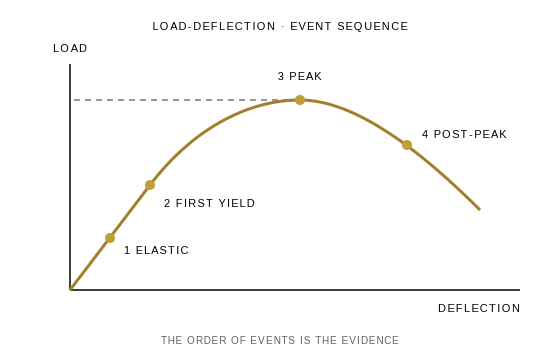
The test article is a repaired configuration built the way the repair would exist in service: a rack column section with the repair kit installed per its instructions, or a configuration representing defined impact damage plus its repair. The specimen is mounted in a load frame with load cells recording applied force and displacement transducers distributed along the member, with particular attention to the splice and interface regions where a repair changes the load path. Loading typically proceeds monotonically in compression, following the protocol the applicable standard defines for the comparable original member so results can be read against the same basis; where the engineering question involves repeated or reversing demand, cyclic protocols apply instead. The essential design of the program is comparative: the repaired configuration is evaluated against the unrepaired original section tested under the same conditions, so the result is not just a capacity number but a defensible answer to whether the repair restores the assumed behavior. Extracted quantities include capacity, stiffness of the repaired region relative to the original, and where and how the specimen ultimately failed — at the repair interface, in the parent member, or elsewhere. The documented comparison becomes the evidence behind a repair product’s performance claims, an engineer’s evaluation of a proposed repair detail, and installation guidance grounded in observed rather than assumed behavior.
Related assumptions
The assumptions on the line
Repair restores design capacity
A repaired or post-impact configuration still supports the original design assumptions.
“Repaired” is a claim about restored behavior, not appearance — the repaired load path is a new structure that has never been tested.
Member capacity vs. published values
Beams, arms, shelves, and decks carry what their published load tables state.
Tables outlive the tooling, suppliers, and details that produced them; the table stays printed while the product underneath it changes.
Related standards
Related standards
ANSI MH16.1ANSI MH16.3
We test to the reference the standard defines — not to convenience.
Evidence visuals
What the setup and the numbers look like
Reading
Further reading
Certification relevance
A repair kit is a product with performance claims, and comparative test evidence showing the repaired configuration restores the assumed behavior can anchor a certification evidence packet for the kit. Certification would cover the product and its claims, not any individual field repair, which still depends on installation quality and site condition.
Testing provides evidence; it does not itself certify a product. Certification is a separate function.
Questions engineers ask
Frequently asked questions
Does testing a repair kit prove that every field repair is safe?
No. Testing establishes how the tested repair configuration behaves under controlled loading. Field safety also depends on installation quality, the actual damage being repaired, and site conditions, which is why test evidence is typically paired with engineering review and field verification.
Why test a repaired column instead of just calculating its capacity?
A repair changes the load path, and spliced or clamped interfaces do not always behave the way a calculation assumes. Testing shows how the repaired configuration actually carries load, which either confirms the calculation assumptions or reveals where they need adjustment.
Can a rack keep its original load rating after impact damage?
Not automatically. An impact can reduce capacity even when the damage looks minor, and a repair only restores the rating if the repaired configuration actually supports the original design assumptions. Testing and engineering review together provide the evidence for that decision.
How is a repair kit test program scoped?
Around comparison. The repaired configuration is tested against the original unrepaired section under the same protocol, and if the kit applies across a family of column sections, the program brackets that family rather than testing one midpoint case. The scope follows from the range of claims the manufacturer intends to publish.
Does a static test of a repaired column answer seismic questions?
Not by itself. A static result establishes capacity and stiffness under a single loading direction, while seismic demand is repeated and reversing. If the rack’s design relies on cyclic behavior through the repaired region, that question calls for a cyclic protocol — the two results answer different assumptions.
Is lab testing of a repair a substitute for inspecting the damaged rack?
No. Laboratory testing establishes how a defined repaired configuration behaves; inspection determines what actually happened to the rack in the field and whether the tested configuration applies. The two work together: inspection identifies the condition, and test evidence supports whether the proposed repair restores the design assumptions.
Is this the assumption you need checked?
Tell us what you make, what changed, and what you need to know — we’ll confirm whether this test answers your question, or point you to the one that does.