

Lab testing · Test type
Shelf-to-Post Shear Connection Testing
Customer questionCan the connections between my shelves and posts actually carry the load the shelves transfer to them?
The short answer
What this test tells you
Every pound placed on a shelf travels through small connections — clips, rivets, or tabs — before it reaches the posts. This test measures how much load those connections can actually carry before they slip or give way, and shows exactly how they fail. In many shelving products, the connection is what limits capacity, not the shelf or the post. A measured connection strength means your shelving capacities rest on evidence instead of assumption, which matters when an engineer, buyer, or certification reviewer asks what your ratings are based on.
Why it matters
What decision does the result support?
In many shelving systems the connection, not the shelf or the post, governs capacity, and small changes in tab geometry, punching, or material gauge can shift its behavior. If the assumed connection resistance is wrong, the capacity of every shelf level built on it is wrong as well. A measured connection resistance replaces that assumption with evidence a reviewing engineer can use.
What the evidence supports
- product development
- manufacturer claims
- product certification
- engineering review
- code/standard compliance support
Typical project situations
- Qualifying a rivet, clip, or tab connection design
- Verifying connection capacity after a tooling or geometry change
- Establishing connection inputs for shelving design calculations
- Supporting shelving capacity claims with traceable evidence
- Investigating connection slip or deformation concerns
- Comparing connector design revisions on a measured basis
What you receive
Test reports
The primary deliverable is the test report: what was tested, to which reference, with what instrumentation, what was measured, and what the result means for the assumption in question. What a test report contains is described on the Test reports page.
Important distinctions
What does this test not prove?
This is a static, non-cyclic test: it measures shear resistance under monotonic loading and does not characterize connection behavior under repeated or reversing loads. It is a component test, not a system test — it does not evaluate shelf bending, post capacity, or the stability of the assembled unit. It also differs from a partial-assembly static shelf test, which evaluates the shelf performing with its connections in context; the shear connection test isolates the connection so its resistance can be measured directly.
The question is not simply whether something held load. The question is whether the assumptions behind the design remain valid — and every test answers only the question it was designed to ask.
Whether this method is inside SMHE Lab’s accredited scope is stated in the Scope of Accreditation. Ask us to confirm before relying on an accredited result.
The assumption
What assumption does this test check?
The assumption that shelf-to-post connections can transfer shelf loads into the posts at the static shear resistance the design relies on.
What it evaluates
What does this test evaluate?
Shelf-to-post shear connection testing measures the static shear resistance of the connections that carry shelf loads into the posts — the clips, rivets, tabs, or engagement details that form the load path in boltless and clip-type shelving. The test measures the load at which the connection slips, deforms, or loses capacity, and records the deformation behavior along the way. Because every pound placed on a shelf reaches the posts through these connections, the result characterizes the link the rest of the shelving design depends on.
Technical detail
How does the test work?
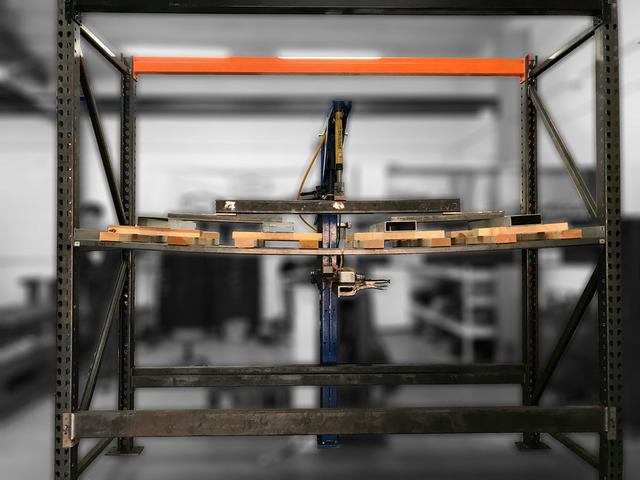
Shelf-to-post shear connection testing isolates the connection that carries shelf loads into the posts — the rivet, clip, or tab engagement of boltless and clip-type shelving — and loads it in shear in a fixture that represents the in-service load path. The specimen is the connection as produced: actual post section, actual connector, engaged the way assembly instructions engage it. A calibrated load system applies static shear per the protocol the governing standard defines, while displacement transducers record relative movement between the connected parts. Loading proceeds monotonically while load and deformation are recorded continuously. The extracted quantities are the connection’s load–deformation response, the loads associated with slip, yielding, or loss of capacity, and the observed governing failure mode — tab bending, slot tearing, rivet shear, or local distress in the post wall. Because connection results are sensitive to small geometric details, programs test replicate specimens so scatter is measured rather than assumed, per the requirements the standard defines. The result is a measured static shear resistance with a documented failure mode, reported with connection details, engagement condition, and the full recorded response under the applicable MH28 provisions. That value becomes the connection input in shelving design calculations and the evidence behind capacity claims — the measured strength of the link every shelf level depends on.
Related assumptions
The assumptions on the line
Connection strength
The connection can develop the moment and shear the analysis assigns to it.
Connector geometry, weld quality, and fabrication drift move strength while the part still looks identical to the one that passed.
Production consistency
Units coming off the line today still match the design that was validated.
Supplier, tooling, and process changes accumulate quietly; service history validates the past, not the current production run.
Related standards
Related standards
ANSI MH28.1ANSI MH28.2
We test to the reference the standard defines — not to convenience.
Evidence visuals
What the setup and the numbers look like
Reading
Further reading
Certification relevance
Measured connection shear resistance is core component-level evidence a certification program (such as SMHE Certified) can evaluate for shelving products, since the connection often governs the capacity a certification would attest to.
Testing provides evidence; it does not itself certify a product. Certification is a separate function.
Questions engineers ask
Frequently asked questions
What does a shelf-to-post shear connection test measure?
It measures the static shear resistance of the connection that carries shelf loads into the posts — the clip, rivet, or tab engagement that forms the load path in boltless and clip-type shelving. The test records the load at which the connection slips, deforms, or loses capacity, along with its deformation behavior. The result is a measured connection resistance the shelving design can rely on.
Does this test cover repeated or seismic loading?
No. This is a static, non-cyclic test, so it characterizes connection resistance under monotonic loading only. Behavior under repeated or reversing loads is a different question that requires cyclic testing, and a static result should not be presented as evidence of cyclic performance.
Why test the connection separately instead of just loading a shelf?
A loaded shelf tells you how the assembly performed, but it does not isolate the connection’s resistance or its governing failure mode. Testing the connection directly produces a measured input that engineers can apply across configurations, and it reveals whether the connection or the shelf governs. The two tests are complementary — they validate different assumptions.
Why are multiple specimens tested for a single connection design?
Connection results scatter because small geometric variations — punching tolerances, engagement depth, material gauge — move the result from specimen to specimen. Testing replicates, per the requirements the governing standard defines, measures that scatter instead of assuming it away. The design value is derived from the family of results, not from a single best specimen.
When should a shelf-to-post connection be retested?
Whenever the details the original result depended on change: tooling, tab or slot geometry, material gauge, post section, or supplier. Shear connections are sensitive to small changes that leave parts looking identical, so a design change review should ask whether the tested configuration still describes production. The existing report covers the connection that was tested, not the one shipping today.
What does the connection test report include?
It documents the connection detail and engagement condition, the loading direction, the load–deformation response for each specimen, the derived resistance, and the governing failure mode with photographs. Failure-mode documentation matters as much as the number: it tells the engineer what mechanism the design value represents.
Is this the assumption you need checked?
Tell us what you make, what changed, and what you need to know — we’ll confirm whether this test answers your question, or point you to the one that does.