

Lab testing · Test type
Stub Column Testing
Customer questionWhat is the actual compressive capacity of my rack column section?
The short answer
What this test tells you
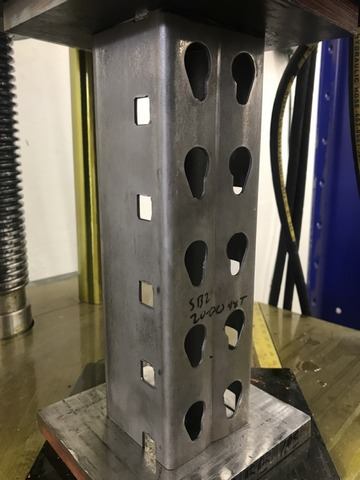
A stub column test answers a basic question: how much compression can this column section really carry? We cut a short piece of the actual production column, place it in a calibrated load frame, and compress it until it reaches its limit while recording exactly how it behaves. The result is a measured capacity for the section — not a calculated estimate. That number becomes the foundation for load tables, seismic evaluations, and responses to plan check questions. Testing turns the assumption behind every column calculation into evidence you can put in front of an engineer or building official.
Why it matters
What decision does the result support?
For years, portions of the industry assumed section efficiencies of roughly 0.90 to 0.95. SMHE’s stub-column testing produced lower values, and independent European research reported Q ≈ 0.64 for a 3×3×14Ga section — roughly a third lower than assumed, with direct seismic consequences. When the efficiency assumption is wrong, every downstream capacity that depends on it is wrong with it, which is why this test sits at the base of defensible rack column design.
What the evidence supports
- product development
- engineering review
- plan check response
- code/standard compliance support
- manufacturer claims
- seismic evaluation
Typical project situations
- Developing a new upright or column section
- Verifying section capacity after a supplier, material, or tooling change
- Establishing test-derived inputs for load table development
- Seismic evaluation of an existing product line
- Responding to plan check or engineering review comments on column capacity
- Comparing perforation patterns or section design revisions
What you receive
Test reports
The primary deliverable is the test report: what was tested, to which reference, with what instrumentation, what was measured, and what the result means for the assumption in question. What a test report contains is described on the Test reports page.
Important distinctions
What does this test not prove?
A stub column test measures the compressive capacity of a short column length; it does not evaluate overall column stability, upright frame behavior, or connection performance, which depend on bracing, base fixity, and system effects addressed by other tests. It also differs from a material tensile test: a coupon measures the properties of the steel, while a stub column test measures how the formed, perforated section actually carries compression after production effects. A measured stub column result is not the same thing as a published table value — it is the evidence a defensible table value should trace back to.
The question is not simply whether something held load. The question is whether the assumptions behind the design remain valid — and every test answers only the question it was designed to ask.
Whether this method is inside SMHE Lab’s accredited scope is stated in the Scope of Accreditation. Ask us to confirm before relying on an accredited result.
The assumption
What assumption does this test check?
The assumption that a column section’s effective compressive capacity — its section efficiency — matches the value used in design calculations and load tables.
What it evaluates
What does this test evaluate?
Stub column testing applies axial compression to a short length of a cold-formed or hot-rolled column section to determine its compressive strength and behavior. Cold-formed rack columns typically include perforations, bends, and thin walls whose local buckling behavior is difficult to capture fully in calculation. The test measures how the finished, perforated section actually carries compression — including local deformation and the load at which capacity is reached — and converts an assumed section efficiency into a measured one.
Technical detail
How does the test work?
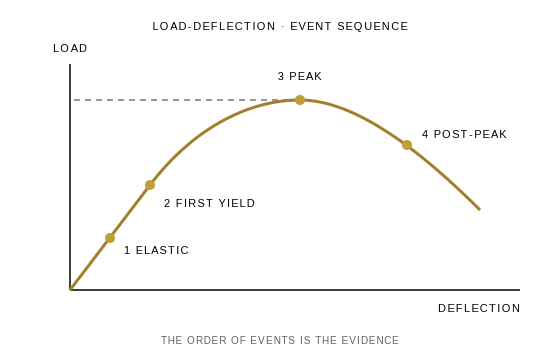
A stub column test loads a short length of the finished column section in axial compression. The specimen is cut from production material at a length short enough that overall column buckling does not intervene, so the measured response reflects the section itself — its perforations, bends, thin walls, and forming effects. Specimen ends are prepared to bear evenly against the platens of the load frame, since uneven bearing distorts the result; end preparation follows the method the governing standard defines. Instrumentation typically includes load measurement through the frame’s calibrated load cell and displacement transducers tracking axial shortening, with additional sensors added where local plate behavior is of interest. Loading proceeds monotonically to peak per the protocol the standard defines, while load and shortening are recorded continuously. The primary extracted quantities are the ultimate compressive load and the load–shortening curve, from which the section’s effective compressive capacity — its measured efficiency relative to computed section capacity — is derived. Companion material coupon tests establish the steel properties so section behavior can be separated from material variation. The deliverable is a measured section capacity traceable to specimen dimensions, material properties, and recorded response. That value becomes the basis for column design inputs and load table development under ANSI MH16.1, replacing an assumed efficiency with an evidenced one.
Related assumptions
The assumptions on the line
Section efficiency (Q-factor)
The perforated, cold-formed section carries the share of its computed capacity the efficiency factor assumes.
The industry assumed a stub-column efficiency factor of 0.90–0.95 for years. SMHE’s testing produced lower values, and independent European research reported Q ≈ 0.64 for a 3×3×14Ga section — roughly a third lower than assumed.
Finished-part material properties
The finished component retains the strength and ductility the design took from the material certificate.
Roll-forming, punching, welding, and cold work change the part — strength can stay high while ductility drops. The certificate describes the coil, not the column.
Related standards
Related standards
ANSI MH16.1ANSI MH16.3ASTM A370
We test to the reference the standard defines — not to convenience.
Evidence visuals
What the setup and the numbers look like
Reading
Further reading
Reading on this assumption
From the publications archive
- Are We Penalizing Modern Steel? Rethinking Q-Factor Corrections in Rack Design
- Why Higher-Strength Steel Doesn't Always Deliver Proportionate Gains in Axial Capacity?
- No Free Lunch in Column Design: Why Bigger Isn't Always Better
Published articles live in the Knowledge Center; shorter notes in the publications archive.
Certification relevance
Stub column results establish the measured section capacity behind column and upright ratings, making them core structural evidence a certification program (such as SMHE Certified) can evaluate for any product line whose load tables depend on section efficiency.
Testing provides evidence; it does not itself certify a product. Certification is a separate function.
Questions engineers ask
Frequently asked questions
What does a stub column test measure?
A stub column test applies axial compression to a short length of a column section to measure its compressive strength and behavior. Because it tests the finished section — with its perforations, bends, and production effects — it captures local buckling behavior that calculations based on gross section properties can miss. The result is a measured section capacity rather than an assumed one.
How is a stub column test different from a material tensile test?
A tensile test measures the properties of the steel itself, such as yield strength and ductility. A stub column test measures how the formed, perforated column section carries compression as a structural shape. Strong steel does not guarantee an efficient section, which is why the two tests answer different questions and are often run together.
Does a stub column test tell me the capacity of the whole upright frame?
No. A stub column test characterizes the section itself over a short length; it does not evaluate overall column stability, bracing behavior, base fixity, or frame action. Frame-level capacity depends on those system effects, which are addressed through other tests and engineering analysis that use the stub column result as an input.
How many stub column specimens does a test program require?
It depends on how many distinct sections you need to characterize and on the replicate and bracketing approach the governing standard defines. A family of similar sections can often be covered by testing representative members that bracket the range, rather than testing every variant. Scoping starts with the sections your load tables actually rely on.
Why do specimen end conditions matter in a stub column test?
Because the specimen is short, how its ends bear against the load frame strongly influences the measured result — uneven bearing concentrates load and can distort the capacity the test reports. The governing standard defines acceptable end-preparation methods, and the method used is documented in the report. This is a detail worth asking about, because it affects comparability between test programs.
What does a stub column test report contain?
The report records the specimen’s measured dimensions and perforation pattern, the material properties from companion coupon tests, the test method and end conditions, the recorded load–shortening response, and the derived section capacity. Each reported value traces to a specific specimen and dataset. That traceability is what makes the result usable in engineering review and plan check.
Is this the assumption you need checked?
Tell us what you make, what changed, and what you need to know — we’ll confirm whether this test answers your question, or point you to the one that does.