

Lab testing · Test type
Rack Deck Testing
Customer questionWill these wire decks actually carry their rated load on our beams, with acceptable deflection?
The short answer
What this test tells you
Rack decks are the shelves your pallets actually sit on — most commonly wire decks — and each one carries a rated load on its label. This test puts a deck on beam supports in the lab, loads it, and measures what it really holds, how much it sags, and how it behaves at the beams. A rating is an inherited assumption until the deck behind it has been measured — wire, welds, and channels all change with sourcing. The result tells you whether the label matches the product, which protects buyers, backs load labels with evidence, and answers due-diligence questions before a sourcing change.
Why it matters
What decision does the result support?
A deck rating is an assumption until the specific construction behind it has been tested — wire gauge, weld quality, channel count and orientation, and support condition all change capacity and deflection. Decks that deflect excessively or release at the supports put stored product and the people below it at risk, and capacity labels that cannot be traced to test evidence are difficult for engineers and buyers to rely on. Testing connects the rating to measured behavior.
What the evidence supports
- product development
- manufacturer claims
- code/standard compliance support
- engineering review
- retrofit/due-diligence decisions
Typical project situations
- Establishing or verifying the rated capacity of a new wire deck design
- Qualifying a change in wire gauge, mesh pattern, or channel configuration
- Evaluating waterfall configurations and support conditions on different beam types
- Comparing decks from alternate suppliers before a sourcing change
- Supporting load labels and capacity tables with test evidence
- Due-diligence review of decks with unknown or undocumented ratings
What you receive
Test reports
The primary deliverable is the test report: what was tested, to which reference, with what instrumentation, what was measured, and what the result means for the assumption in question. What a test report contains is described on the Test reports page.
Important distinctions
What does this test not prove?
A rated load on a label is a claim; this test measures whether the deck as built supports that claim. Capacity is not the only question — a deck can hold its rated load while deflecting more than intended or behaving poorly at the waterfall, so deflection and support behavior are part of the evaluation. The test evaluates the deck, not the rack: beam capacity, frame capacity, and overall rack behavior are separate questions. Results apply to the tested configuration, so a change in channels, wire, or support condition calls for renewed evidence.
The question is not simply whether something held load. The question is whether the assumptions behind the design remain valid — and every test answers only the question it was designed to ask.
Whether this method is inside SMHE Lab’s accredited scope is stated in the Scope of Accreditation. Ask us to confirm before relying on an accredited result.
The assumption
What assumption does this test check?
The wire deck’s rated capacity and expected deflection remain valid for the deck as actually built — its wire pattern, channel supports, and waterfall configuration — on the intended beam support condition.
What it evaluates
What does this test evaluate?
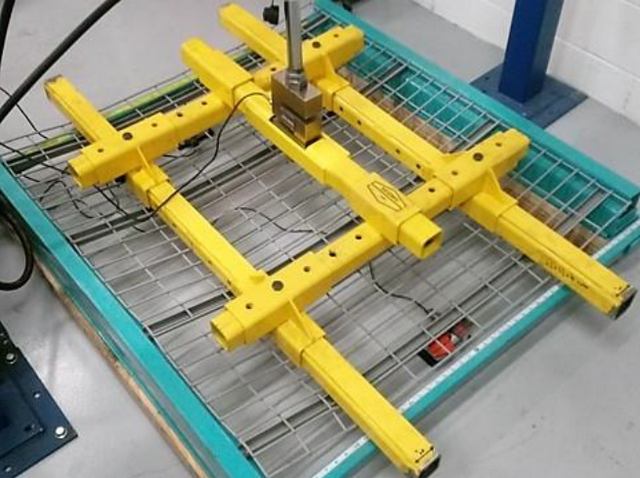
Rack deck testing evaluates the decking that spans the beams and carries the stored load — most commonly wire decks, tested per ANSI MH26.2. Controlled loading is applied to a deck on representative beam supports while capacity, deflection, and behavior at the supports are measured. The deck is evaluated as a system: the wire mesh, the support channels, and the waterfall edge detail that wraps over the beam, since each of these affects how load actually reaches the beams. The test shows whether the rated load printed on a label corresponds to the measured behavior of the deck configuration being sold or installed.
Technical detail
How does the test work?
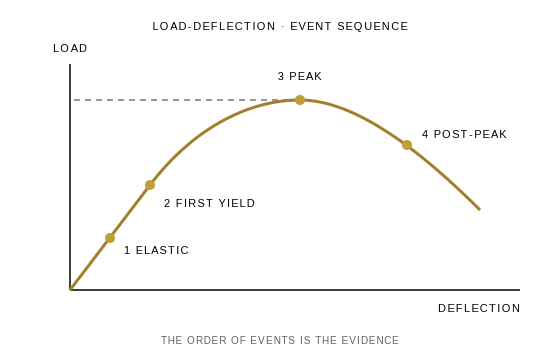
The deck is tested as a complete manufactured unit — wire mesh, support channels, and the waterfall edge that wraps over the beam — placed on beam supports representative of the intended installation, because the support condition changes how load reaches the beams. Loading proceeds per the protocol ANSI MH26.2 defines, applying controlled load while instrumentation records deflection. The test tracks three things. Capacity: the load the deck sustains and the mode by which it ultimately fails. Deflection: how much the deck sags under working-level load, which governs usability long before strength does. Support behavior: how the waterfall and channel ends seat on the beam, since a deck that releases from its supports is a hazard regardless of its mesh strength. Failure modes such as weld fracture in the mesh, channel distress, or support disengagement are documented photographically. The output connects a rated load to measured behavior: the tested configuration is described in full — wire gauge, mesh pattern, channel count and orientation, and support condition — so a capacity label, load table entry, or engineering review can trace the rating to a specimen and a test record rather than to an inherited number. Because results belong to the tested construction, the report also states the configuration limits within which the evidence applies.
Related assumptions
The assumptions on the line
Deck rated capacity
Wire decking supports its rated load with the deflection behavior the rating implies.
Wire diameter, weld quality, and support conditions drift with sourcing — capacity vs. rated is an assumption until measured.
Member capacity vs. published values
Beams, arms, shelves, and decks carry what their published load tables state.
Tables outlive the tooling, suppliers, and details that produced them; the table stays printed while the product underneath it changes.
Production consistency
Units coming off the line today still match the design that was validated.
Supplier, tooling, and process changes accumulate quietly; service history validates the past, not the current production run.
Related standards
Related standards
ANSI MH26.2ANSI MH16.1
We test to the reference the standard defines — not to convenience.
Evidence visuals
What the setup and the numbers look like
Reading
Further reading
Reading on this assumption
From the publications archive
Published articles live in the Knowledge Center; shorter notes in the publications archive.
Certification relevance
Deck capacity and deflection tests are direct certification evidence: they connect the rated load on a product’s label to the measured behavior of the actual construction being sold.
Testing provides evidence; it does not itself certify a product. Certification is a separate function.
Questions engineers ask
Frequently asked questions
What does wire deck testing under ANSI MH26.2 involve?
The deck is placed on representative beam supports and loaded while capacity, deflection, and support behavior are measured. The result shows whether the deck’s rated load and expected deflection hold for the actual wire pattern, channels, and waterfall configuration.
If a deck carries its rated load, is the test passed?
Not necessarily. Deflection at working load and behavior at the supports matter as well — a deck can hold its rated load while sagging beyond what an application tolerates or seating poorly on the beam. A useful test evaluates the full behavior, not just the peak number.
Do wire deck test results transfer to a different deck configuration?
Only within limits. Results describe the tested construction — wire gauge, mesh, channel count and orientation, and support condition. Changing any of these can change capacity and deflection, so a modified configuration generally calls for its own test evidence.
How many wire decks need to be tested to support a rating?
It depends on the range the rating must cover — deck constructions, spans, and support conditions — with replication per the protocol the standard defines. A rating that covers a product family is typically supported by testing the bounding configurations, so one program defensibly covers the range being sold rather than one deck.
Does a wire deck test say anything about the rack beams or frame?
No. The test evaluates the deck — its mesh, channels, and behavior at the supports — not the beams it rests on or the rack around it. Beam capacity, frame capacity, and overall rack behavior are separate questions answered by their own tests and analysis.
How does a wire deck test support a load label or capacity table?
The report documents the tested construction and support condition alongside the measured capacity and deflection, which lets the label or table entry be traced to a specimen and a test record. That traceability is what makes the rating something an engineer, buyer, or official can rely on rather than an assertion.
Is this the assumption you need checked?
Tell us what you make, what changed, and what you need to know — we’ll confirm whether this test answers your question, or point you to the one that does.